
My labor of love, my Sistine Chapel, growing and evolving with my own growth over the years, has been my book series, The Legends of Àea. This Christian High Fantasy work, inspired by my own literary heroes, is comprised of several different series. The Legends of Àea is the umbrella term for all of these works. Àea is a land of legend that I have labored over for years, worldbuilding with numerous historical events, around 7,000 years from the Creation until the apparent Cataclysm that will throw the whole series in a much different direction. Feel free to explore the various series I am working on. I also have supporting material concerning my worldbuilding available through the link below. Below the links, find some more of my thoughts on it, and writing in general. Originally, this was intended to be a forward for the first book I wrote in my Daughters of Agendale series, but I have since removed and revised it for when I eventually re-release that book.


Winston Churchill once said this: “Writing is an adventure. To begin with, it is a toy and an amusement. Then it becomes a mistress, then it becomes a master, then it becomes a tyrant. The last phase is that just as you are about to be reconciled to your servitude, you kill the monster and fling him to the public.” My book series has indeed passed neatly and cleanly through each phase of this cycle, sometimes more than once.
It has been almost like a child to me: in its inception I was enamored with it, watching it grow and evolve. At times I felt like I wasn’t even writing it; I felt like it was somehow a living thing of its own, mysteriously being produced by my fingers and mind as if in a dream. As it grew bigger so did its demands (just like a child). The vast number of names required hours upon hours of attention, as my compulsions mandated that I provide meanings for each. This led to the creation of my “language file,” a beast in and of itself, where like a bent over lab technician I labored on grammar and verb conjugation charts, along with vast lists cataloging each name of a person, place, sword, or concept. After the first story was completely written, I sighed in relief and prepared for editing. Like a foolish neophyte parent who has been too busy rushing through the early years with his first child, I suddenly realized that my “adolescent” book was deeply flawed. Errors of all kinds leapt from the pages, even after it was copyrighted and in its first printed form. The editing process ripped from me what joy and wonder remained at that point, until I realized with shame that I could no longer stand the book. What I had created I now hated. As I would feel about a wayward child, I could never truly cast it away. On the inside I still loved it, and indeed always would. But outwardly I distanced myself from it. I left it, moving on to other works, trying new ideas, hoping it would eventually go away.
Those new ideas, which ended up being its sequels, prequels (of which Worthy is the first), and spin-offs of this book, ultimately added to the disappointment, disdain, and difficulty I had developed with the first book, then titled The Legend of Eloeen. They changed many plot concepts and altered and expanded the lore in profound and wonderful ways, which served to make the prospect of rewriting vast swaths of my first book simply unthinkable. It was no longer my wonder-filled baby or my developing child, nor indeed was it my rebellious, hateful teenager. It was now an angry old man, sitting in a nursing home glaring back at me with resentful eyes, recounting in that gaze my neglect of it. I had grown since I handled it last, and so had the legendary world I had created. Simply put, The Legend of Eloeen no longer fit within the history of Àea, and I owed it to the work and to myself to fix it.
My present goal has been to extradite this pitiful thing from its nursing home and breathe into it new life, or perhaps more accurately, raise it from the dead. I have had to trim and add until it once again fits into the puzzle that is Àea’s Legends. And being the first of the Daughters series, it is arguably the most important.
Some may ask what I am trying to say with this book. Well, my first goal is actually no goal. I have to write. It is a strange and sometimes cruel fact but despite numerous attempts and even long hiatuses I have never been able to abandon writing. I may be absolutely no good at it, or I may be a literary genius. I don’t know for sure. But it doesn’t matter, because I am compelled by some inward force to make up these ridiculous stories. I like to think that is because my work has some meaning beyond simple entertainment. Which, by the way, is my second goal. No fiction work is really worth reading if it does not serve as a diversion from reality. Fiction, and fantasy in particular, are powerful genres because through them we project an exaggerated image of our philosophical beliefs. There is a reason that even the Bible itself has stories within the stories, included in order to emphasize or clarify a real-life ideal or principle. The prophet Nathan could have simply delivered news of God’s displeasure with David’s sin when he murdered a man for his wife. But instead the prophet used a story to draw out David’s own ideal of justice, one which he used as an allegory to emphasize not how God or Nathan felt about such evil deeds, but how much David himself despised what he had done.
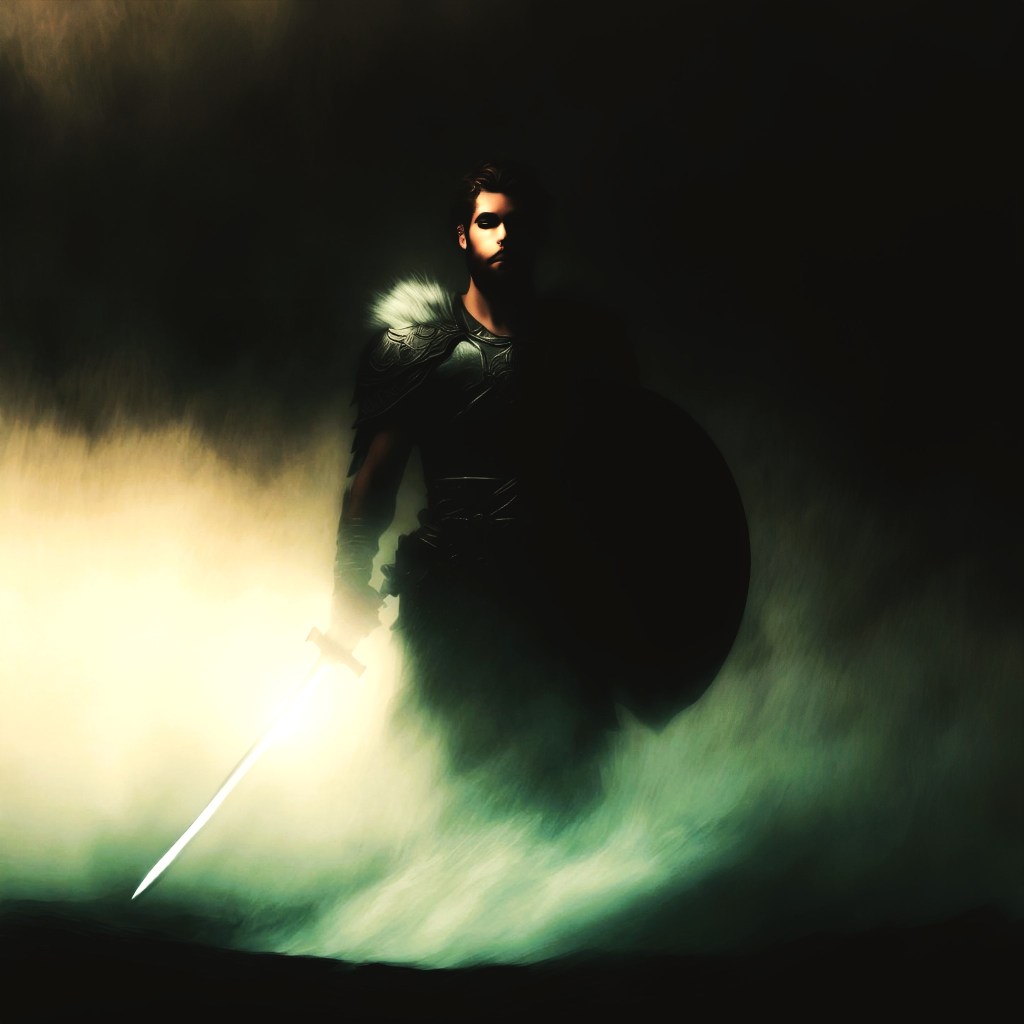
And that is what good fantasy really is: a way of drawing out the truths and good in life and displaying them in sharp contrast to the lies and evil. All life is a battle between good and evil, but in reality this battle is sometimes mired in gray areas, feelings, circumstances, and simple blandness. We struggle against the evil of being selfish with our kids or spouse. We struggle against temptations with money or faithfulness. But very rarely do we struggle against overtly dangerous evil. And that is why fantasy is so appealing. It reminds us that evil is still evil, especially in God’s sight, whether it is lying to your boss, or a vicious six-legged demon from an ancient world. It is that reminder‒of the reality of the Battle‒that gives meaning to what seems to be a comparatively insignificant existence. In many ways, the Battle is best represented internally, as the Bible tells us, with our greatest nemesis being our own propensity to do evil. In that sense, we are the ancient demon. But we are also the shining hero with upraised shield. That is what fantasy does for us, beyond simple entertainment.
Which brings me to the third and final goal: to teach. All books are instruction manuals. Through books, authors communicate their own ideals, their own characters, their own principles, and their own desires. It is inescapable. No author can separate himself from his work: it is a literal part of him. This is what makes the Bible so powerful and special, for its author was the perfect God of Creation. The books I have written are not in any way so powerful or unique, for its author is just another flawed mortal man. But perhaps through it I can share some of the truths that I have learned from the Great Book, and from life itself, while at the same time entertaining you with a diversion from whatever reality is for you.
 Word Weld