
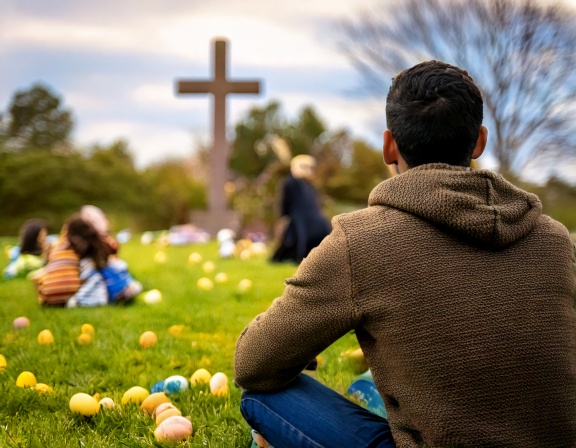
In terms of holidays observed by Americans, Easter doesn’t really measure up. It’s generally considered (at least by my reckoning), to be inferior to Christmas, Thanksgiving, New Years, and Forth of July, but in an ill-defined way better than Valentines Day or Saint Patrick’s day. It might rate similar on many people’s scales to Memorial Day, as a holiday that is mostly eating related, with some vague higher meaning that you’re supposed to care about, but nobody really notices if you don’t. It seems to rank below Halloween, unsurprisingly, especially as a candy themed holiday. And like virtually all holidays that have Christian themes, Easter gets trashed annually on the internet for having apparently been “appropriated” from some pagan festival that no one has really ever heard of except in TikTok videos made by atheists and actual pagans trying to claim a “gotcha” against Christians, and with it a few clicks to help their presence online. In general, the world finds Easter to be rather lackluster, having undesirable Christian ties, traditions only really enjoyed by young children, and a bunny mascot that is rather unimpressive compared with the likes of Santa or even Cupid. The only thing about Easter that most of America agrees on is that they have the best candy of any holiday on the calendar. On that last point, they’re right, too. I don’t know what it is about shaped Reese’s that makes them taste better than the others, but it’s a fact that among the various Reese’s candies, the pumpkins rank above the standard cups, but are beat out by the Christmas trees. But above all Reese’s stands the Reese’s Egg, which is truly a marvel of confectionary delight. But I digress.
Now, in churches, Easter rates a little differently. Most Christians and churches know that Easter is of great significance, and so they have special decorations, special music, and many even have special services. They know that unsaved people or unfaithful Christians show up to Easter services to do their good deed for the Spring, just in case God is real and they should be doing something to make Him like them. Many Bible-believing, non-progressive churches also know why it’s special, and preach sermons on the true meaning of it, and true Christians love to hear those messages.
But I’m here to say that at least we as Christians and churches do not do enough in my opinion to celebrate the resurrection of our Lord. Christians are not told in the Bible to observe holidays specifically, but the example set for us in the Old Testament is that God sees great value to us in celebrating the things that He has done on behalf of His people. There were seven feast days that were commanded by God, which are found in the Law of Moses. These are found in several places in the Books of the Law, but especially Leviticus chapter 23, which serves as a kind of summary of these feasts or celebrations. These holidays or “holy days” were special times that God commanded the Jews to observe. But why did God command them to have these special days, these “holidays?” The answer is simple: to remember God’s works. Consider the end of God’s instructions on the Feast of Booths (or Tabernacles):
And ye shall keep it a feast unto the Lord seven days in the year. It shall be a statute for ever in your generations: ye shall celebrate it in the seventh month. Ye shall dwell in booths seven days; all that are Israelites born shall dwell in booths: That your generations may know that I made the children of Israel to dwell in booths, when I brought them out of the land of Egypt: I am the Lord your God.
Leviticus 23:41-43
God commanded the Jews to keep seven feast “days,” though some lasted longer than a day. Each holiday possessed its own traditions, and whatever the traditions or the symbolism was, all of it was designed with the purpose of reminding them of the things God had done and to teach their children about those things. Human beings are forgetful, easily distracted, and prone to having the wrong priorities, even as adults, and these celebrations were times that these things can be brought to mind. Very briefly (and I mean that, because there is a lot to the Jewish holidays), let’s consider what each of these feasts was to remind them of. I would love to do a study in the Jewish Feast Days, because there is so much symbolism in them, both toward Jehovah and what He did for Israel, as well as the coming of Christ.
- The Passover (Pesach) – This feast reminded the Israelites of God’s deliverance from Egypt, His miracles, His love for Israel, and His dominance over their enemies. It is one of the most important feast days.
- The Feast of Unleavened Bread (Chag HaMatzot) – This feast was concurrent with the Passover and was to remind them of the removal of leaven that God required, partially because they left in haste from Egypt and had no time for bread to rise, and also because leaven represented impurity and so they were to remove it from their homes.
- The Feast of Firstfruits (Yom habikkurim) – This feast was to call to mind that all of the firstfruits (everything from their animals to their crops to their children) belonged to God because of the Passover. A lamb was offered, picturing Christ, along with bread and wine, the same symbols used in observance of the Lord’s Supper.
- The Feast of Weeks (Shavu’ot) – This feast was to call to mind the giving of the Law to Moses, as this occurred 7 weeks after the Exodus from Egypt.
- The Feast of Trumpets (Yom Teru’ah) – This feast marks the beginning of the Jewish new year. It was a time to stop work, to look inwards and consider how you stand with God. Not only does it harken to the trumpet that will be heard when Christ returns, it seems obviously a reference to the time of introspection spent before taking the Lord’s supper.
- The Feast of Atonement (Yom Kippur) – Perhaps the most recognized of the Jewish holidays by Christians (besides the Passover), the Day of Atonement was the holiest day to the Jews and was when the High Priest would offer a sacrifice for the sins of the whole nation. It is a clear picture of Christ’s death upon the cross and payment for the sins of the world.
- The Feast of Tabernacles (Sukkot) – Tabernacles were temporary dwellings, just as the Tabernacle that the Lord had Moses build was a temporary dwelling. But the Jews also lived in temporary shelters during their time in the wilderness, and during this time Jews would not live in their houses, but for seven days would live in temporary “booths” as a reminder of the passage of their ancestors through the wilderness and how God provided for them.
Now, why go through all that? Why take up so much time talking about these Jewish holidays? Well, because it is worth noting that they were established by God to help His people remember important things. Well, you say, but you can’t just make up holidays for things that aren’t in the Bible, right? I submit to you that this precedent was established exactly for that purpose. Anything that God has done in your life is worth celebrating, and some things are worth celebrating annually, to remember what He has done for you personally, and for your family. And this is proved by another Jewish Feast Day that is in the Bible, yet was not commanded by God. And that day was Purim, or the Feast of Lots, when the Jews celebrated their deliverance from the Persian ruler Haman, recorded in the Book of Esther. This event was so pivotal for the Jews that they created their own holiday and added it to the calendar, and nowhere in the Bible is action condemned by God. Now typically arguments from silence aren’t the best, but if it was not sanctioned by God, why did He allow it to be recorded in the canon of Scripture ? After all, the Book of Esther doesn’t even mention Him at all, yet it is there all the same. Does this not conform to what we read elsewhere in Scripture? The Apostle Peter says this:
Yea, I think it meet, as long as I am in this tabernacle, to stir you up by putting you in remembrance; Knowing that shortly I must put off this my tabernacle, even as our Lord Jesus Christ hath shewed me. Moreover I will endeavour that ye may be able after my decease to have these things always in remembrance.
II Peter 1:13-15
True, Peter wasn’t establishing a holiday himself, but he did say that he would endeavor that they would have ways of remembering what he was telling them. He was most likely referring to the epistles he wrote, but the purpose is served regardless. Is that not why would put Bible verses on wall art, and place bumper stickers on our cars, and symbols on the jewelry women wear? All of these things, besides witnessing in a general way what we believe, are reminders. And holidays are simply the biggest reminders.
Christmas isn’t celebrated exactly on the day Christ was born, because we don’t really know when that was, but it doesn’t matter. It does not exist for us to venerate a particular day, it’s to remember a particular Person, and to remember that at one point, on a certain day, something tremendous took place. It’s a celebration that we all undertake as believers in general, because something happened on that day that had never happened before. And, unknown as it is, that is a day we want to call to remembrance in a special way, and regularly. Christmas is the day was celebrate the fact that on a certain, unknown day, God the Son, knowing that He could only pay for our sins as a man, became a man. He took upon Him flesh, flesh that He would never lay down, flesh in which He would spend all of eternity to come… flesh that will forever bear the wounds that represent the debt He paid for you and me. Christmas should be celebrated, every year, in spite of whatever the world is doing with Santa and their notions about what the day means. Because in the end, when we decorate a tree, or have a big feast with a turkey, or open presents, or decorate our houses, we as Christians aren’t just having fun, we’re remembering that Jesus Christ, the Lord of Glory, became one of us to save us.
And in like manner Easter, or Resurrection Sunday if you prefer, isn’t about egg hunts or spring decorations or Reese’s eggs. It’s not about the color white, or lilies, or bunnies. It’s about reminding ourselves that the same Lord who took upon himself our nature, did so in order to have it pierced and beaten and wounded, so that our sin could be banished from us, that could be banished in no other way.
Who hath believed our report? and to whom is the arm of the Lord revealed? For he shall grow up before him as a tender plant, and as a root out of a dry ground: he hath no form nor comeliness; and when we shall see him, there is no beauty that we should desire him. He is despised and rejected of men; a man of sorrows, and acquainted with grief: and we hid as it were our faces from him; he was despised, and we esteemed him not. Surely he hath borne our griefs, and carried our sorrows: yet we did esteem him stricken, smitten of God, and afflicted. But he was wounded for our transgressions, he was bruised for our iniquities: the chastisement of our peace was upon him; and with his stripes we are healed. All we like sheep have gone astray; we have turned every one to his own way; and the Lord hath laid on him the iniquity of us all. He was oppressed, and he was afflicted, yet he opened not his mouth: he is brought as a lamb to the slaughter, and as a sheep before her shearers is dumb, so he openeth not his mouth. He was taken from prison and from judgment: and who shall declare his generation? for he was cut off out of the land of the living: for the transgression of my people was he stricken. And he made his grave with the wicked, and with the rich in his death; because he had done no violence, neither was any deceit in his mouth. Yet it pleased the Lord to bruise him; he hath put him to grief: when thou shalt make his soul an offering for sin, he shall see his seed, he shall prolong his days, and the pleasure of the Lord shall prosper in his hand. He shall see of the travail of his soul, and shall be satisfied: by his knowledge shall my righteous servant justify many; for he shall bear their iniquities. Therefore will I divide him a portion with the great, and he shall divide the spoil with the strong; because he hath poured out his soul unto death: and he was numbered with the transgressors; and he bare the sin of many, and made intercession for the transgressors.
Isaiah 53
Let’s normalize reading Isaiah 53 in the days leading up to easter, to remind ourselves that we aren’t just going through the motions, or even necessarily trying to save people ourselves, but that we are doing what we do because Jesus died for us. He suffered so that we wouldn’t have to. His life, as the song says, for mine! Because He lives, as the song says, we can face tomorrow! Hallelujah, Christ arose! He died to cleanse us from our sins, but He rose so that we might rise also.
Colossians 1:18
And he is the head of the body, the church: who is the beginning, the firstborn from the dead; that in all things he might have the preeminence.
He was the firstborn, meaning that they will be others. We are the others! What a thing to celebrate! Christmas is a wonderful time, it is true, when we realize that Christ became one of us, but this is fulfilled at Easter when we celebrate why He came, what he accomplished, and who He accomplished it for! This year, I’m planning to celebrate Easter in some special ways with my family at home. We’re going to make some new Easter traditions, some based on Jewish feast days, others perhaps of our own invention. Why? Because I want our family to really remember what Christ did.
Many people in Christianity do not like feast days or traditions. They feel like extra laws or rules that we have to follow. Some of that likely comes from the abuses of the Jewish leaders of Jesus’ day, who had come to a place where they had truly abandoned the meaning of all their traditions while continually adding more and more to no purpose. Some likely chafe at celebrations and traditions because of the Catholic Church, and its many, many “traditions.” Some might see a bunch of extra traditions invented and followed by Baptists, and see Baptists going through the motions all the time and therefore come to despise traditions in general. But in every case, it isn’t the tradition itself that is the problem, but the men and women who are performing the tradition. Does it serve to remind us of something we often forget? Does it draw our hearts and minds away from temporal, transitory things and toward heavenly things? Does it remind us of God’s provision for us, of His love and care, and of our need to be close to Him? If the answer is yes, then that is a tradition we need to get behind, and have more of in general. Consider Deuteronomy chapter 11.
Therefore shall ye lay up these my words in your heart and in your soul, and bind them for a sign upon your hand, that they may be as frontlets between your eyes. And ye shall teach them your children, speaking of them when thou sittest in thine house, and when thou walkest by the way, when thou liest down, and when thou risest up.
Deuteronomy 11:18-19
The language here speaks of “binding” and of “frontlets” which are references to phylacteries. These were small boxes containing strips of parchment on which were written texts of Scripture, usually the Law itself. The Jews did and many still do take this literally, and I don’t honestly think God has a problem with that. Literally binding God’s word onto your very arms, hands, or having it hang down in front of your face… honestly, there are far weirder and worse things that you could do, and many people actively do.
Traditions that remind us of God, His promises, His sacrifice for us, or our need for Him are, I submit, wholly acceptable, and even pleasing to God. It is a way of realizing (that is, of making real) our faith, which is otherwise capable of just becoming taken for granted. As long as your traditions have meaning, have them, and have as many as help you realize what God’s done for you, because we are forgetful creatures. I forget why I came into a room, I forget to get gas, I forget what my kids names are, I forget where I put things, forget to take my lunch to work, and the list goes on. Why wouldn’t I also sometimes forget the Jesus died for me? Why wouldn’t I also forget that I love Him more than this world? Why wouldn’t I forget that I owe Him everything? Why wouldn’t I forget that He answered my prayers so many times, and provided for us so marvelously? I would, and I do. Because I am a human being and I am forgetful. But if a made-up tradition or a family holiday or something we do special once a year reminds me in some way of something that I have done for God, then let’s do it. It may be weird, it may be out of the ordinary, and our friends might not be doing it, but who cares? What we do for God, He will honor.
So, whether like me you’re planning to start some new traditions around Easter, or if you’ve got some that work for your family and you’re doing them again for the umpteenth time, let’s resurrect our love for the Resurrection. Let’s remember that what we’re about to celebrate is the second and most critical of two miracles that the Son of God did for us because He loved us. Let’s make Easter time a time to really look forward to, for ourselves, for our kids, for our families, for our churches, because this one is worth celebrating. If we celebrate nothing else, but celebrate this, then we do well.
But the Jews that were at Shushan assembled together on the thirteenth day thereof, and on the fourteenth thereof; and on the fifteenth day of the same they rested, and made it a day of feasting and gladness. Therefore the Jews of the villages, that dwelt in the unwalled towns, made the fourteenth day of the month Adar a day of gladness and feasting, and a good day, and of sending portions one to another.
Esther 9:18-19
 Word Weld
Leave a comment