
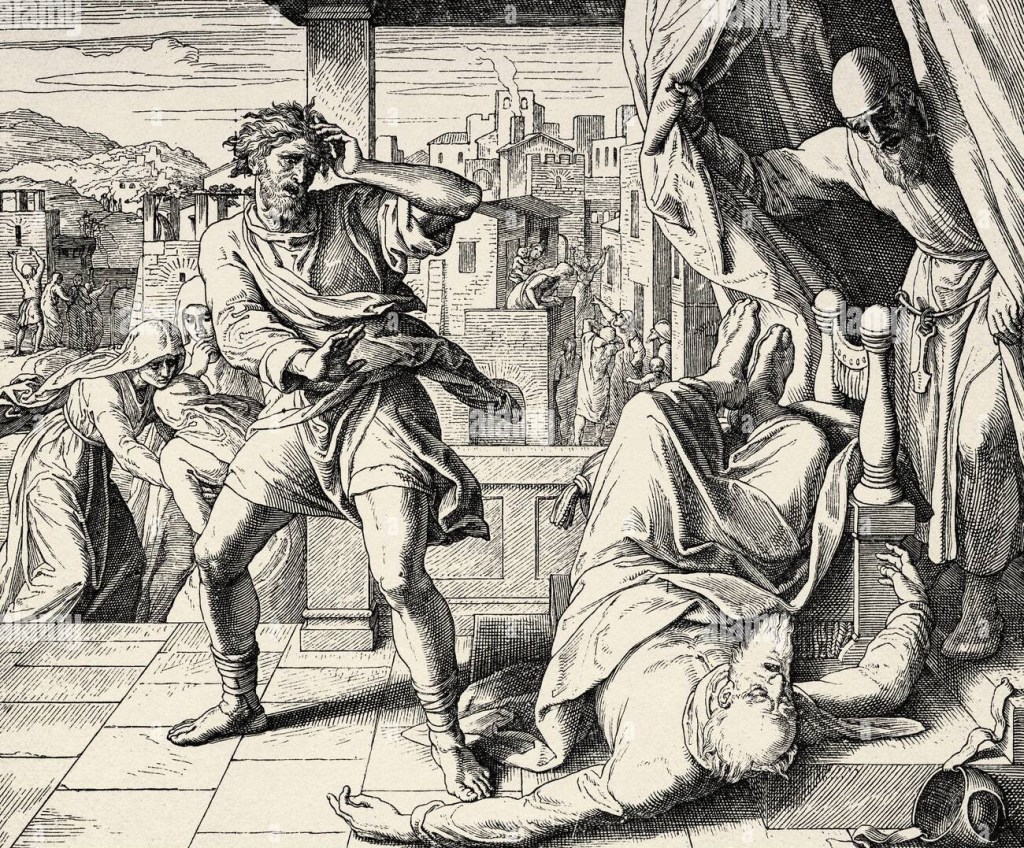
[This is part two of a study on II Samuel 12, that began last week with my article, Thou Art the Man.]
Earlier we took a look at David’s failure with Bathsheba. We explored how he was forced to come to terms with his sin and how Nathan accomplished that. As we rejoin David and Nathan at the throne room, David has fallen into the prophet’s trap and his own judgment and condemnation has been turned upon himself, leading to dismay and humility. He has, even in his lowest moment, proven himself to be a man near to God’s own heart. And as he repents, Nathan assures him that his sins are covered in God’s eyes: they will not stand against him in the Judgment Day. His faith and belief in God’s salvation have through Christ allowed God to cover those sins, to pass over them, to put them behind him. But correction is still needed, and harsh correction. But why? God had already told David through Nathan that his sin had been “put away.” Nor can we say, as I thought initially during my look through this passage, that this was simply the consequences of his actions that God was allowing him to experience. No indeed, all of what follows from David’s sin is specifically credited to God in the passage:
Now therefore the sword shall never depart from thine house; because thou hast despised me, and hast taken the wife of Uriah the Hittite to be thy wife.
II Samuel 12:10-12
Thus saith the Lord, Behold, I will raise up evil against thee out of thine own house, and I will take thy wives before thine eyes, and give them unto thy neighbour, and he shall lie with thy wives in the sight of this sun.
For thou didst it secretly: but I will do this thing before all Israel, and before the sun.
When I sat down to write Thou Art the Man, as I indicated above, and I came to the portion of the story when Nathan delivers punishments to David, I personally wanted to create a kind of analogy to the average Believer, which is something that can be done often in these Old Testament stories, and not without reason. After all, both the Apostle Paul (in I Corinthians 10) and the author of Hebrews state that the stories told by the Old Testament, far from being irrelevant to us in our Age of Grace, are just as important as they ever were, for they are “ensamples” (a Greek word meaning a shape or model). They teach us something about God and about ourselves, no matter how different the culture or era. So I wanted us to place ourselves in David’s shoes, and to an extent, you can, because God chastises His children as any good father. However, David’s punishment seems much more severe than I expected, and it took me by surprise at first. Notice God’s language.
“Because you have despised me…“
“Behold I will raise up evil against thee…”
“I will take thy wives before thine eyes…”
“For thou didst it secretly: but I will do this thing…”
God is very severe with David. Contrast this to many of the people that Jesus dealt with in His earthly ministry. Notice that even when they were obvious sinners, and sometimes caught in the very act, they were treated with compassion and mercy. Even Judas Iscariot, the traitor, Jesus addressed with no strong rebuke even on the night he betrayed him, and none of his punishment was earthly in nature. Now, I know that God seems (not is but seems) different in the Old Testament, the Old Testament shows forth the pure, blinding, burning, terrifying rightness of God, a truth and a purity that defines those words and is so intolerant to sin and corruption that it dies or burns in His presence. This aspect of God is alluded to in Hebrews when we find these words:
For our God is a consuming fire.
Hebrews 12:29
The Old Testament is specifically constructed this way, showing how a people could not live rightly even when given step-by-step instructions and means to clear their sin. This contrasts strongly with the New Testament and thereafter, where Jesus is literally absorbing all of that onto himself, standing as an eternal High Priest by a death He hadn’t even accomplished yet (during his early ministry), but which God Himself honored. This is how He was able to make God seem different to us, because He was able to shield us from God’s wrath, or perhaps a better way to say it is that He shielded our wickedness from God’s sight.
During our family devotion with my older children, as we have read the Pentateuch, and specifically Leviticus, my kids could not help but comment afterwards on how terrible God seems, on how unapproachable he seems, and how breaking even what we would consider the smallest of rules would often mean death itself. And to them I explained it this way: God is so holy and so righteous that even his very presence drives out and destroys evil. And since the Israelites (and we ourselves) were corrupted by their sin, they could not stand in God’s presence. It was only the covering of their sins, and the careful adherence to those laws, that permitted them to be even near the Tabernacle at all. It is as if God were a fiery furnace. There is nothing wrong about a furnace, it’s just hot. To be even near it you would have to put on safety gear to cover nearly your whole body. So it was with God: the blood of bulls, rams, sheep, and birds was meant to cover them so that they could abide God’s intense holiness.
The Old Testament is built this way for a good reason: to make clear how significant Christ’s death and resurrection were. They were to shield all of us from fire of the furnace, but not by covering us up, but allowing us to put on fire ourselves, to be righteous in our being, through our transformation into a Child of God, of whom the Man Christ is the firstborn.
God’s standards are high, His very nature consuming righteousness. But even so, why is God so severe with David, despite His love and care for him? Well, therein lies the linchpin of this article and one of the more somber and sobering truths of the Bible and how Jesus has established His church. David was not just an ordinary man. Look at how God talks to David through Nathan immediately after the story about the poor man’s lamb.
Thus saith the Lord God of Israel, I anointed thee king over Israel, and I delivered thee out of the hand of Saul;
II Samuel 12:7b-9
And I gave thee thy master’s house, and thy master’s wives into thy bosom, and gave thee the house of Israel and of Judah; and if that had been too little, I would moreover have given unto thee such and such things.
Wherefore hast thou despised the commandment of the Lord, to do evil in his sight? thou hast killed Uriah the Hittite with the sword, and hast taken his wife to be thy wife, and hast slain him with the sword of the children of Ammon.
God takes the time to remind David that to God there is something different about him. He reminds David that he anointed David King. David was not just a man who believed in God, or had faith in God, or even just an Israelite. He was a man God had chosen to lead others. He held David to a much higher standard because he had entrusted him with so much responsibility, and so much blessing. I am reminded of the words of Christ:
And that servant, which knew his lord’s will, and prepared not himself, neither did according to his will, shall be beaten with many stripes.
Luke 12:47-48
But he that knew not, and did commit things worthy of stripes, shall be beaten with few stripes. For unto whomsoever much is given, of him shall be much required: and to whom men have committed much, of him they will ask the more.
The burden of leadership is a heavy one, and God takes it very seriously, both with David, and at other times as well. Remember Eli and his sons? His whole family was punished for generations because God held Eli and his sons responsible for forsaking the high standard of the priesthood that He had called them to. Eli raised and trained Samuel, and the Bible says nothing bad about his service. It does not say that he himself did anything amiss or against the law, but his failure and his punishment were in the area of leadership.
And the Lord said to Samuel, Behold, I will do a thing in Israel, at which both the ears of every one that heareth it shall tingle.
I Samuel 3:11-13
In that day I will perform against Eli all things which I have spoken concerning his house: when I begin, I will also make an end.
For I have told him that I will judge his house for ever for the iniquity which he knoweth; because his sons made themselves vile, and he restrained them not.
Notice the similarity between God’s punishment of Eli, and God’s punishment of David. Notice just how seriously God takes it when these men who are leaders of God’s people fail in their responsibility to lead. Both David and Eli sinned in the area of family, and that directly affected the people that they were responsible to lead, and as a result God punished them severely. I Samuel 4 tells how as part of his punishment, Eli’s sons both die during a battle with the Philistines, punished personally for their gross immorality, violence, and abuse of power. Eli, however, dies as well. But even that is not the end. God’s judgment rests upon Eli’s house.
We see this much, much later, in the book of I Kings, long after most of us have really forgotten about Eli, if you’re reading through the Bible. Eli appears at the beginning of I Samuel and dies in chapter 4, and he is not heard of again, but then his name and accompanying judgment suddenly appears again in I Kings, when his descendant, Abiathar, has his own judgment dealt with. Abiathar was Eli’s great great grandson. Of Eli’s two wicked sons, Phinehas fathered Ahitub, who fathered Ahimelech, who fathered Abiathar. Remember, Ahimelech was the high priest during the reign of king Saul, and Saul killed Ahimelech when he unwittingly helped David escape from Saul. For this Saul killed Ahimelech and all his children as well, but Abiathar somehow survived (1 Samuel 22:20). Abiathar went on to follow David and was a good man, but in I Kings we see that in the end he, along with Joab, tried to make Adonijah, one of David’s other children, king instead of Solomon, whom God and David had chosen. Because of this treachery, Solomon strips him of his office. In verse 13 of I Kings chapter 3, the Bible interestingly and suddenly mentions Eli again, and you are forced to sit back and wonder that God had not forgotten what he promised to Eli and Samuel concerning His judgment:
And unto Abiathar the priest said the king, Get thee to Anathoth, unto thine own fields; for thou art worthy of death: but I will not at this time put thee to death, because thou barest the ark of the Lord God before David my father, and because thou hast been afflicted in all wherein my father was afflicted.
I Kings 3:11-13
So Solomon thrust out Abiathar from being priest unto the Lord; that he might fulfil the word of the Lord, which he spake concerning the house of Eli in Shiloh.
Notice how long it took and how many generations were affected by Eli’s sin. God held him to a much higher standard because of his position. He was the high priest, and he allowed his sons to do not just incorrect, but blatantly immoral, blasphemous acts in God’s holy place. For this God punished his whole house, for five generations.
Similarly, David is punished with, as Jesus put it in Luke 12, many stripes. He not only loses his son, but his family is also cursed with infighting and immorality. We see later on that one of his sons rapes his own sister, and that son is then murdered by his half-brother, who then tries to take the throne from David. Some scholars even believe that Ahithophel, David’s friend and advisor, was Bathsheba’s grandfather, and that the plot to dethrone David was by him as well, making him a part of David’s extended family, though I cannot conclusively say this is true (it is possible that the Eliam mentioned in II Samuel 11:3 as Bathsheba’s father is in fact the same Eliam mentioned in II Samuel 23:34 as the son of Ahithophel, but they may have been different people).
Regardless, the infighting goes on when the aforementioned Adonijah attempts to usurp the throne from Solomon, whom David and God had chosen to assume the throne after David’s passing.
Very quickly, I would also like to mention this as an aside, but a very important aside: both of these men were leaders of God’s people, but notice that both of their sin involved a failure in the home. Not only were these two leaders held to a higher standard because of their leadership over God’s people, but their failure was as fathers. They both failed to lead their homes. Now, not many of us will be leaders in the church necessarily, but every father is a leader in his home, and if he does not teach, guide, and restrain his children, God will hold him accountable for that failure, make no mistake.
But we go on, and I want to get to the important parts here. David and Eli are both leaders and fathers and their failures were held to a higher standard because of that leadership. Notice why that is important. Let’s go back to Nathan’s speech to David.
And David said unto Nathan, I have sinned against the Lord. And Nathan said unto David, The Lord also hath put away thy sin; thou shalt not die.
II Samuel 12:13-14
Howbeit, because by this deed thou hast given great occasion to the enemies of the Lord to blaspheme, the child also that is born unto thee shall surely die.
So here we have it. The reason that leaders in the church, leaders over God’s people, and yes fathers also, are held to a higher standard is clear: they represent God directly. When lost people see Christians engaging in the same sinful behaviors that they do, they can scoff, but when lost people see leaders falling from grace, it is a different story entirely. They are given great occasion to blaspheme. They have enabled and emboldened those who fight with the Devil to discredit not only themselves, but God Himself. And this is a failure that God takes very, very seriously.
My brethren, be not many masters, knowing that we shall receive the greater condemnation.
James 3:1
James goes on to say that leaders offend many people in many ways because of their position. Meanwhile, the author of Hebrews adds also:
Obey them that have the rule over you, and submit yourselves: for they watch for your souls, as they that must give account, that they may do it with joy, and not with grief: for that is unprofitable for you.
Hebrews 13:17
Paul also puts in quite a few words about the dire seriousness of leadership when his own leadership is questioned by the believers at Corinth, who were engaged in cliquish behavior, choosing a “patron saint” if you will to follow like fans following their favorite team captain. And Paul at the end of I Corinthians 3 corrects them, telling them to follow Christ, and then in chapter 4 says:
Let a man so account of us, as of the ministers of Christ, and stewards of the mysteries of God.
I Corinthians 4:1-4
Moreover it is required in stewards, that a man be found faithful.
But with me it is a very small thing that I should be judged of you, or of man’s judgment: yea, I judge not mine own self.
For I know nothing by myself; yet am I not hereby justified: but he that judgeth me is the Lord.
To be judged by the Lord for your failure to lead His people is indeed a terrible thing. When God chooses someone to lead, be it a pastor, or a song leader, or a missionary, or an evangelist, or a Sunday school teacher, or a youth pastor, or a pastor’s wife, or even a father or mother, He calls them to a higher standard of living, and His loving correction will be much more severe, because to whom much is given, much is expected. This is a fearful thing, and it becomes more so when we see God condemn the many leaders in Israel, who failed in their duties to lead their people into godliness, holiness, and purity. And I’m not just talking more about David and Eli, there are many unnamed leaders spoken of throughout Scripture. One of the most scathing passages is a long one, found in Ezekiel 34, which I think it is important to take the time to read completely, with every verse like a hammer blow, showing just how God takes it when those He places over His children, here called his “flock,” forsake doing the right thing and use their power and authority for themselves. I highly encourage you to go read the entire chapter, but here is an excerpt:
Son of man, prophesy against the shepherds of Israel, prophesy, and say unto them, Thus saith the Lord God unto the shepherds; Woe be to the shepherds of Israel that do feed themselves! should not the shepherds feed the flocks?
Ezekiel 34:2 & 10
…
Thus saith the Lord God; Behold, I am against the shepherds; and I will require my flock at their hand, and cause them to cease from feeding the flock; neither shall the shepherds feed themselves any more; for I will deliver my flock from their mouth, that they may not be meat for them.
Over in the minor prophets, we get similar strong language from the prophet Micah, who brings God’s words to the same kinds of failed leaders:
Hear this, I pray you, ye heads of the house of Jacob, and princes of the house of Israel, that abhor judgment, and pervert all equity.
Micah 3:9-12
They build up Zion with blood, and Jerusalem with iniquity.
The heads thereof judge for reward, and the priests thereof teach for hire, and the prophets thereof divine for money: yet will they lean upon the Lord, and say, Is not the Lord among us? none evil can come upon us.
Therefore shall Zion for your sake be plowed as a field, and Jerusalem shall become heaps, and the mountain of the house as the high places of the forest.
There are other, numerous places in Scripture that we could go to, but I think that we will end that line of discussion by hearing Jesus’ words against the Jewish leaders, who were, again, chosen by God to lead His people, just as David, Eli, and the leaders of Ezekiel’s and Micah’s days. And for them His language is just as strong:
And whosoever shall exalt himself shall be abased; and he that shall humble himself shall be exalted.
Matthew 23:12-14
But woe unto you, scribes and Pharisees, hypocrites! for ye shut up the kingdom of heaven against men: for ye neither go in yourselves, neither suffer ye them that are entering to go in.
Woe unto you, scribes and Pharisees, hypocrites! for ye devour widows’ houses, and for a pretence make long prayer: therefore ye shall receive the greater damnation.
We’ve seen it before, so many times before, with so many churches. God raises up leaders, and for a time they continue, but they do not remain steadfast. For some, it is a lust for power, to lord over the people of God and “exalt himself,” as Matthew records. For others, it is Mammon, filthy lucre, or put simply greed, exploiting the people of God for personal wealth. Jude compares such people to the Gentile prophet Balaam, who God punished for his greed. For others still, they fall due to a sense of moral superiority that blinds them to their own sinful nature, which Paul warns against when he says in I Corinthians 10.
Wherefore let him that thinketh he standeth take heed lest he fall.
I Corinthians 10:12
And then there is simply time, wearing men down and weakening their defenses, until they either actively give up, or allow sin or Satan an occasion to infiltrate and destroy them and undermine their ministry.
I have been personally impacted by this on several occasions, and I can attest that as always God is right. A leader fell and gave Great Occasion to the enemies of God. My own family has felt this hurt deeply over the years, personally, and so have so many others. Leaders in the church are discovered in immoral behaviors or relationships, or are caught embezzling, or start elevating themselves like secular tyrants, or manipulating people under them for their own gain. Others simply become fed up and disillusioned and backslide, which gives great occasion to the enemies of God to say, “Look at them! Christianity has nothing to offer even the best of them!”
That’s why it humbles me, and scares me, though I am not called to be a pastor myself, to accept or volunteer for leadership in my church. I consider it a privilege, but also terrifying. I have taught Sunday School, been a music leader, and very rarely filled a pulpit as a layman during difficult times. Each time there is a special burden upon me not to fail. But even every day, as I lead my home, as I lead my wife and my children, there is a terrifying burden of responsibility to me as the head of my home, and I am as one “that shall give account.” I will stand before the Judgment Seat one day, and know that in addition to whatever else I will be asked to answer, He will say to me, “When I asked you to take a position of leadership over my people here, why did you do this?”
That is why I pray for guidance whenever I am asked to lead, and stay humble, as David did, and try not to do it on my own or think too much of myself. When people thank me or compliment me on something I did or said, I try to act gracious, but to give God the Glory, because He deserves it, not me. Leaders and shepherds that God places over His people have a tremendous burden and should be supported and prayed for, because they are under attack, and for one of them to fall will cause great damage to the cause of Christ.
 Word Weld
Leave a comment