
[This is a two-part study on II Samuel 12, but as I was composing the part 1, it became clear that it was too long, so I will have to publish part 2 next week.]
Today I just want to take a break from social issues and do a little Bible study, a little dive into II Samuel 12, and take two separate and yet connected thoughts out of this passage.
This passage has of course received a lot of attention from pastors and teachers throughout history, and rightly so. David, the man after God’s own heart, the man to whom God promised an heir who would reign forever, and a kingdom that would never end, is nonetheless recorded engaging in willful sin. If the Bible were not the book it is, and was just another historical account or even a work of fiction, one would expect the account of David to be spotless, washed clean by Jewish writers whose mission would be to make David’s reign as squeaky clean as possible. But like Solomon after him, all of the greatness that he rightly is accredited is marred by an act explained in detail. God instructed the author of II Samuel (likely the prophet Nathan himself, or possibly Gad, who was a close friend of David and a prophet in his own right) to include this account of David’s failure on purpose.
Now before I go any further, perhaps another student of the Word is saying, “Well, the matter with Bathsheba was not David’s only recorded sin. You also have to mention the matter of David pridefully numbering the people of Israel and God punishing him for that.”
I will not say much about that here. The reason is that it isn’t quite the same. David’s adultery with Bathsheba and the premeditated murder of her husband Uriah came wholly from David. It was his own lust, and the punishment that he received was directed wholly at him. The matter with the numbering of the people and the plague that followed is probably worthy of its own separate study, because according to the passage, the numbering of the people was something that God instigated, and that makes it a very unusual subject. Consider how that passage begins:
And again the anger of the Lord was kindled against Israel, and he moved David against them to say, Go, number Israel and Judah.
II Samuel 24:1
So, the matter with the numbering and what followed was a punishment upon the nation of Israel itself, and God was using David as an instrument to that effect. This is a unique story in the Bible because it does not say why God was angry with Israel, or why He chose the extra step of moving David against them and bringing judgment upon them that way. This makes the story a fascinating study, but if you want to hear more about that, well, maybe I’ll tackle it sometime.
In the meantime, let’s get back to David and Nathan. I won’t go through the story of David’s sin with Bathsheba, and his plot against Uriah, but remember that his sin is premeditated, and it is elaborate. Not only did he lust after a woman, a married woman, but took her secretly, and then created an elaborate plot to make it seem the child wasn’t his, involving further sins of making a man drunk and trying to get him to violate his conscience. But when that failed David concocted a more sure-fire measure to get rid of Uriah as quietly as possible.
An interesting aside is the fact that David involved his general, Joab, in the plot to murder Uriah, and that Joab was willing and able. Joab is an interesting character in the Bible, and not in a good way. I was interested to discover that he is actually closely related to David. Joab and his two brothers are called “sons of Zeruiah,” and Zeruiah herself is David’s sister according to 1 Chronicles 2:13–17, which makes Joab and his brothers David’s nephews. David had many mighty men who did many great deeds in valor and heroism, but while Joab’s brother Abishai is listed among David’s mighty men, and a chief among three, Joab himself is not. Now, it is likely that David would have considered Joab as one of his mighty men regardless, because he chose Joab to be his general and the leader of his army (and therefore all the other mighty men), but unlike many of David’s mighty men whose deeds are recorded, very few of Joab’s recorded deeds are good. He did fight, against the enemies of Israel, and against other Israelites in some cases, such as the transition period before Abner left the house of Saul and backed David. But Joab is mostly remembered for four things:
- The murder of Abner, a mighty warrior and Saul’s general. (II Samuel 3)
- The murder of Uriah (himself one of David’s mighty men) at the behest of David’s order. (II Samuel 11)
- The murder of Absalom, David’s son. (II Samuel 18)
- The murder of Amasa, another nephew of David and Joab’s cousin. (II Samuel 20)
Joab is an interesting study in himself, but I won’t get too far into him, though we’ll touch on one or two things. In the context of David’s sin with Bathsheba, it is worth noting that Joab’s character was of such a low degree that David did not hesitate to send a letter (tragically and ironically by Uriah’s own hand) telling Joab to kill Uriah by abandoning him in the battle. While it is possible that the letter contained more information than is given, II Samuel says only:
And it came to pass in the morning, that David wrote a letter to Joab, and sent it by the hand of Uriah.
II Samuel 11:14-15
And he wrote in the letter, saying, Set ye Uriah in the forefront of the hottest battle, and retire ye from him, that he may be smitten, and die.
If Joab received no other instructions in the letter, which is what I suspect, then it exemplifies what kind of man Joab was. And David knew that well, for he knew well of Joab’s murder of Abner. In fact, after the slaying of Abner, David himself expressed his displeasure with Joab and his whole family:
And the king said unto his servants, Know ye not that there is a prince and a great man fallen this day in Israel?
II Samuel 3:38-39
And I am this day weak, though anointed king; and these men the sons of Zeruiah be too hard for me: the Lord shall reward the doer of evil according to his wickedness.
The Hebrew for the phrase “too hard” is revealing, because it means “cruel, stubborn,” even “churlish.” It is possible that the Bible was referring to Joab at least, and possibly the rest of his family, in I Samuel 30, where it mentions “all the wicked men and men of Belial, of those that went with David.” A man(or son) of Belial was said to be a vile person, worthless, treacherous, or evil. The phrase was used of multiple evil, churlish people in the Old Testament, and interestingly it is used in I Corinthians by Paul to refer to the Devil himself. It is quite possible that Joab was among these men, considering his manner and behavior, which he further exemplified with his other murders, one of which was David’s own son, Absalom. David likely retained Joab and his brothers in his service because of their skill in battle, and because, as the saying goes, “family is hard to say no to.” They were his kin and that made a difference to him.
So when David needed someone to do a dirty deed, he knew exactly who to call, and Joab did not disappoint. He did not so much as ask any questions, but carried out the deed, even against one of his own trusted warriors, causing Uriah to be slain. David had seemingly covered up his wicked deeds with more wicked deeds. But David’s sin was not hid. Now, perhaps Nathan observed all of this happen, but considering the level of detailed knowledge that he possessed, and David’s own careful attempts to hide it, I think it more likely that God simply told Nathan what David had done. And Nathan obviously feared God more than David, because as King David could have had Nathan himself killed in further attempts to cover up his sin. Or perhaps Nathan knew that David would repent. There’s no way to know for sure. What we do know for sure is that Nathan boldly confronted David, but he didn’t simply walk into David’s presence and say, “I know what you did to Uriah. I know you’re an adulterer and a murderer.” And that’s the main point I want to make: Nathan made David hate what he had done.
Unless you’re a sociopath and have no regard for anyone besides yourself or any kind of shame, all men inherently view certain acts as evil and reprehensible. We all have a moral system in our minds, but because we ourselves are constantly in violation of not only God’s moral system, but oftentimes our very own, we have to make allowances or excuses in order to spare ourselves. C.S. Lewis talked about this in the brilliant book Mere Christianity
He is appealing to some kind of standard of behaviour which he expects the other man to know about. And the other man very seldom replies: ‘To h*ll with your standard.’ Nearly always he tries to make out that what he has been doing does not really go
C.S. Lewis (“Mere Christianity”)
against the standard, or that if it does there is some special
excuse. He pretends there is some special reason in this partic-
ular case why the person who took the seat first should not
keep it, or that things were quite different when he was given
the bit of orange, or that something has turned up which lets
him off keeping his promise. It looks, in fact, very much as if
both parties had in mind some kind of Law or Rule of fair play
or decent behaviour or morality or whatever you like to call
it, about which they really agreed. And they have.
Lewis points out that when we are confronted with our wrongdoing, our first reaction is to excuse our behavior in some way. “Why did you punch that man?” someone says, to which we reply, “He had it coming.” “I told you to pick up those boxes, why didn’t you?” someone says, to which we reply, “I don’t remember you saying that.” And there are ten thousand other examples of excuses that we give for the things we do wrong. But as Lewis says we do not tend to respond to the question “Why did you punch that man?” with the statement, “There’s nothing wrong with punching people.” Instead we try to appeal to a reasoning that we in some way expect the other person to accept, or one that will at least make them think twice before continuing their assault. But it is very hard indeed to find any excuse that will hold water when we ourselves have brought the accusation.
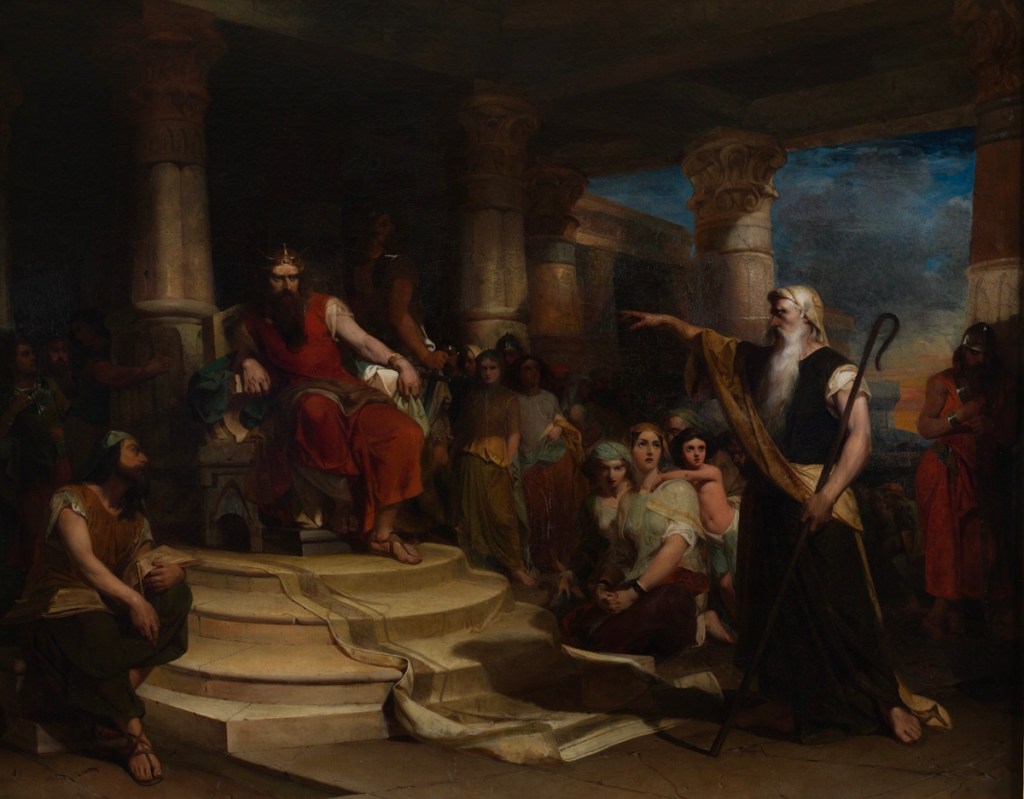
We do not know if God told Nathan how to approach David, or if Nathan of his own mind thought up the story of the poor man’s sheep, but either way it was brilliant. And the brilliance of Nathan’s story lies within this concept of appealing not to another standard, but to David’s own standards. This would be like me telling Matt Walsh (who goes on long rants online about people who don’t return shopping carts) a story about how his kid didn’t return a shopping cart at the store, only to reveal later that in reality Matt was guilty of not returning a book to the library. And Nathan makes it personal. He doesn’t tell a story about cows, or about donkeys, or about lost library books or shopping carts. He tells a story about sheep. And even though David is King of Israel, he remembers well where he came from. He remembers the cold nights on the hills keeping watch over his father’s herds of sheep, and defending them against lions and bears, and working hard to keep them healthy and happy. David knew sheep.
So when Nathan tells his story, David identifies immediately with the poor man. He considers himself to be the victim in a way. As the evil deeds of the fictional rich man come to David’s ears, he sees himself in the poor man, having his only sheep stolen away, and his response proves how strongly he identifies with this wrongdoing.
And David’s anger was greatly kindled against the man; and he said to Nathan, As the Lord liveth, the man that hath done this thing shall surely die:
II Samuel 12:5-6
And he shall restore the lamb fourfold, because he did this thing, and because he had no pity.
It is worth noting that according to Exodus 22, the Law of Moses already had a punishment for this kind of offense. According to Hebrew law:
If a man shall steal an ox, or a sheep, and kill it, or sell it; he shall restore five oxen for an ox, and four sheep for a sheep.
Exodus 22:1
So David, as king, said that the fictional man should follow the law and restore four sheep for the stolen sheep, but not this only. He himself added that in addition to what God required, the man would die. And it was in this moment that Nathan knew that he had David right where he wanted him. David had heard the story, and every word of it made his blood boil. You can hear his anger in the words and in his proclamation. This was personal for him, but he had no idea that all of his just and righteous rage was staring him in the mirror. And the next words of Nathan fell like a hammer striking an anvil:
And Nathan said to David, Thou art the man.
II Samuel 12:7a
You can imagine David’s shock. Nathan goes on to explain what he means (and to make clear that he knows everything that David did), but as someone whose sin has found him out before, I personally believe that David knew exactly what Nathan meant as soon as those four words fell upon his ears.
“Thou art the man.”
“It’s you,” I hear the Bible say when I read this verse. “You’re the one. You’re guilty.” And I realize that like David, all the things I condemn in others, when I see clearly and hear those words, I realize I do.
Therefore thou art inexcusable, O man, whosoever thou art that judgest: for wherein thou judgest another, thou condemnest thyself; for thou that judgest doest the same things.
Romans 2:1-2
But we are sure that the judgment of God is according to truth against them which commit such things.
And no, this verse is not a weapon to club people over the head with. When Nathan told David, “Thou art the man!” David did not immediately quote Romans 2 and say, “Who are you to judge me, Nathan!” Because Nathan had not condemned David. Nathan had not judged David in that sense. He had merely heard God’s word, and determined that David had violated God’s commands. David was judged by God, Nathan was only bringing it to his attention. Romans 2:1-2 is not in the Bible to justify sinful men or silence those who sincerely shed the light of truth upon sin, but to bring humility to those who would condemn others. It is written so that we, when we are calling out sin as we are called to do throughout Scripture, do not forget that we are also sinful men, who are but one misstep from great evil:
Wherefore let him that thinketh he standeth take heed lest he fall.
1 Corinthians 10:12
We are each of us a step away from abandoning principles that we hold firm. We are each of us subject to carnality, even as Believers, even as long-time Believers. Do not forget that Paul was forsaken by his fellow-laborer Demas after years of labor in the ministry, who he said in the end “loved this present world.” Sometimes the process is slow, as it was with King Saul, and sometimes it is rapid, as it was with Judas, but both men ultimately lacked humility. And humility was Nathan’s aim as well, to use David’s own righteous anger to stoke the humility that he knew was present in David, but which had been suppressed by the pride of his lofty station and the fear of the shame he still felt. There is a lot to be said for shame, though it is a dirty word in our society, but I guarantee you that the first emotion David felt after he heard those four words was shame. Shame is a corrective emotion, and while it is not wise to indulge in it, shame is itself pure. Shame is what brought David from his pride down to the humility that was the only thing that could save him from God’s wrath. No prideful man can ever be saved, because God resists the proud, and how can a proud man repent? How could David repent without humility?
“Thou art the man.”
There is a forgotten hymn that is among my favorites, called “I’m the One.” It is not a fun, peppy song. On the contrary, it is heavy, but this heaviness is a state that I believe is required among believers, and occurs at the moment of salvation, when one accepts the free gift of Christ’s forgiveness.
I was not in the garden when He knelt to God and prayed
Ray Overholt (1924-2008)
I did not kiss Him on the cheek when Jesus was betrayed;
I could not do a single thing to hurt God’s only Son
But every time I sin on earth I feel that I’m the one
I was not at the trial when the crowd jeered at His name
I did not make Him bear a cross or walk a road of shame;
I could not do a single thing to hurt God’s only Son
But evеry time I sin on earth I feel that I’m the onе
I was not on the hillside when He gave His life that day
I did not nail His precious hands or take His robe away;
I could not do a single thing to hurt God’s only Son
But every time I sin on earth I feel that I’m the one
I’m the one who shouted “crucify,”
I’m the one who made His cross so high
I’m the one who stood and watched Him die;
What have I done? I’m the one
This type of humility seems heavy and sad, and it is. And it is this heavy, sad sense of humility that leads to unspeakable joy, in the same way that turning the lights out for a full minute and then turning them all back on again will not only make you appreciate the presence of the light more, but will also make the light seem that much brighter as your eyes squint in its brilliance. And we are not to dwell long in the presence of this heaviness. We need to remember it, we need it, but it is not where we live.
And Nathan did not leave David here. He did not utter those fateful words, “Thou art the man!” and then turn on his heel and leave. Nor did he leave after uttering six verses of God’s opinion on what David had done and how he would suffer for it. He didn’t issue God’s judgment and leave. As soon as he was done, and he heard David’s humility when he said, “I have sinned against the Lord,” Nathan lost no time moving on to his next words, which were words of comfort. They were the light piercing the gloom of shame and guilt.
And Nathan said unto David, The Lord also hath put away thy sin; thou shalt not die.
II Samuel 12:13b
Now, in another article I want to go in depth into David’s punishment. God told David that He had “put away” his sin: He spared David’s life, which would ultimately have been required by God, as the punishment for murder is death, according to God’s Law. Keep in mind, this law (concerning murder) predates the Law of Moses (it is found in Genesis 9:6, just after the Flood), though the Levitical Law does echo it (Exodus 20:13). However, he still punished David, and for a good reason, which I will go into in part 2 of this study, Great Occasion. Due to David’s failure as a husband and father, God’s punishment is in kind, and comes from within his fractured and broken family, which David himself had despised with his lust and adultery. But the greatest part of the punishment that God placed upon David was the loss of his child, for which no amount of weeping or pleading would alter, similarly to the sin of Moses in the book of Numbers. But even then, we see the mercy of God, for God allowed David to have another son through Bathsheba, and not just any son, but one that God says specifically that He loved: Solomon. God was not only able to use David’s repented sin to strengthen him, as we see in the Psalms David wrote about this period of his life, but He was also able to turn evil for good, and grant David an heir wiser and more righteous than all of his other children.
Thank God that our sins are put away! The word translated “hath put away” is the Hebrew word עָבַר (aw-bar’, Strong’s #H5674) which means “to cross over, go over, escape, put away.” Its definition is broad, but as with all Hebrew words, getting the full meaning sometimes is best seen in how it is used elsewhere, and it is used in many places in the Bible, over 500. It is used commonly for going over a river, and it is used in Numbers when the Children of Israel sought to go through the lands occupied by other nations on their way through the wilderness. In other words, Nathan uses it here to tell David that God has passed by it, crossed over it, and gone His way. David committed a heinous sin, but due to his repentance, it is passed. Praise God! Instead of receiving God’s punishment, death, David received His correction:
And ye have forgotten the exhortation which speaketh unto you as unto children, My son, despise not thou the chastening of the Lord, nor faint when thou art rebuked of him:
Hebrews 12:5-7
For whom the Lord loveth he chasteneth, and scourgeth every son whom he receiveth.
If ye endure chastening, God dealeth with you as with sons; for what son is he whom the father chasteneth not?
And we share in this mercy. Our sins are put away in Christ, for there is, as Paul wrote in Romans 8:1, no condemnation for the Believer. We shall not die, as Nathan told David. Will there still be consequences for our sin? Yes, correction? Yes. But we do not endure wrath, only correction. We may endure trouble for our sin in this life, but we will not pay for it in the next. The chastening of the Lord may be hard, but it is not to destroy us, but to help us return to God as David did. As the writer of Hebrews continues:
Now no chastening for the present seemeth to be joyous, but grievous: nevertheless afterward it yieldeth the peaceable fruit of righteousness unto them which are exercised thereby.
Hebrews 12:11-13
Wherefore lift up the hands which hang down, and the feeble knees;
And make straight paths for your feet, lest that which is lame be turned out of the way; but let it rather be healed.
Even the “best of us,” as men see it, may fall. Many have. Many will. We are all subject to the same nature, and struggle with carnality, envy, lust, greed, anger, and despair. But we have this assurance: that our sins are purged, and that what we endure now as a result is turned to correction, not destruction, that we might be more righteous than we were before, more Christ-like, more mindful of sin, more able to help others who struggle. That is the peaceable fruit of righteousness. Verse 13 says to make straight paths for your feet… get back on the right path. Don’t let that which is lame be thrown out, but let it be healed, that it might be stronger than ever.
But for the unbeliever, they have no such hope. For them, their sin cannot be turned to righteousness through God’s providence and power. For them, each sin bears only its consequences in this life, and eternal death in the next. Their sins have not been put away, but remain, and God does not pass over it, but will cast it out of His presence at the Last Day. And that is why it is so important (more so than anything else you will ever do) to accept Jesus today, to not let the wrath of God abide upon you any longer than necessary, but to lay your many sins upon Jesus, who has already paid for them with His death upon the cross, so that those that believe should be children of God.
There is therefore now no condemnation to them which are in Christ Jesus, who walk not after the flesh, but after the Spirit.
Romans 8:1-2
For the law of the Spirit of life in Christ Jesus hath made me free from the law of sin and death.
For as many as are led by the Spirit of God, they are the sons of God.
Romans 8:14
…Be not afraid, only believe.
Mark 5:36b

 Word Weld
Leave a comment