
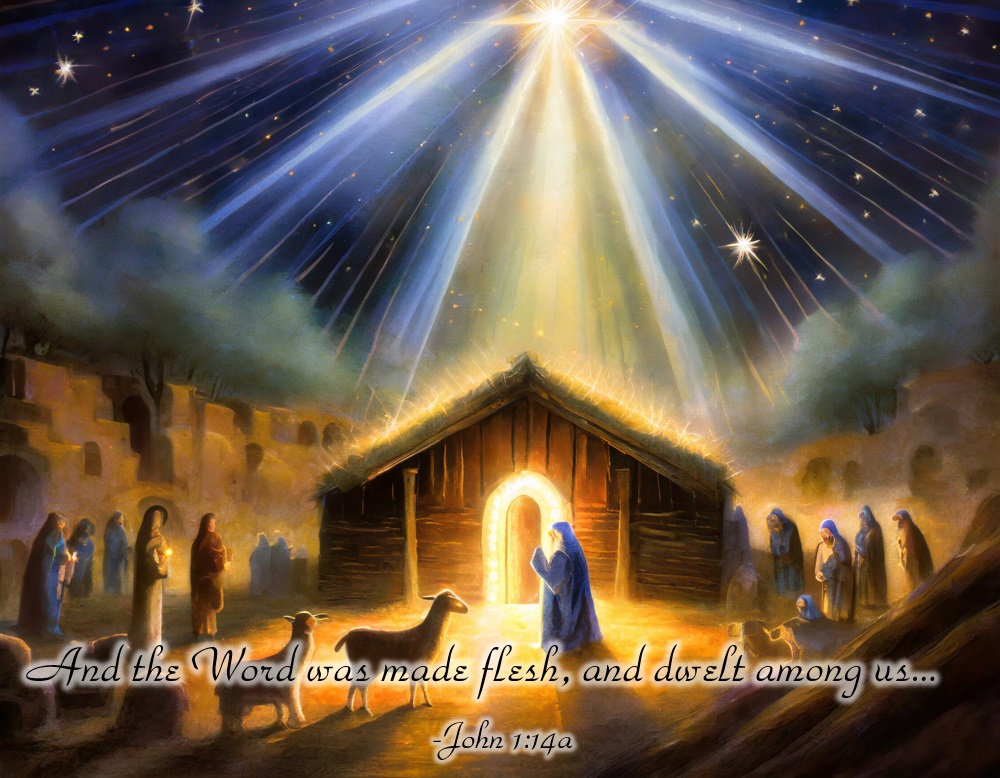
This past weekend I attended a church as a guest and as I was listening, the pastor made a statement that piqued my interest. He asked if we realized that there was right now in Heaven a flesh-and-blood Christ, sitting in glory. As he asked this, I realized that I had never really thought about the implications of Christ assuming human form.
If you were raised in church you know well that Christ became a human being in order to die for the sins of mankind. Christmas is celebrated as the appearance of Christ on the scene of history, arriving to prepare for the dire and horrible (and yet wonderful) fate that he would endure so that we would not be lost forever. I’ve heard numerous messages, as you may have, on the marvelous dichotomy, the divine paradox that Christ was both fully man and fully God. He is often referred to as the God-man, and since the most ancient times cultures have taken this idea and incorporated it into their own myths, the myth of the suffering savior, the “demigod” as the Greeks called it, borrowing the idea from the Hebrew prophets who first brought the idea to the mind of man. But even the Greeks, with their meandering, troubled and troubling stories could not come up with a way to make the man and the God come together in one person outside of sexuality. God and Christ deliberately remove the sexuality from the story, having Christ enter the world through the virgin, something that is also sometimes copied in literature past and present, but again borrowed from the Hebrew prophets.
I learned the essential truths of Christ’s incarnation over the years, and you may know them:
- Christ had to become human because He had to be able to die, and as God He could not die. Sin has an inescapable cost, one that God Himself knew had to be paid to cleanse men fundamentally.
- Christ had to remain God, because a human being could not rise again, thereby providing a path for us toward reconciliation with God through belief in Him.
These truths are laid out plainly in Scripture:
Let this mind be in you, which was also in Christ Jesus: Who, being in the form of God, thought it not robbery to be equal with God: But made himself of no reputation, and took upon him the form of a servant, and was made in the likeness of men: And being found in fashion as a man, he humbled himself, and became obedient unto death, even the death of the cross. – Philippians 2:5-8
Paul, in Philippians, says that Christ was “in the form of God.” John 4:24 tells us that, “God is a Spirit: and they that worship him must worship him in spirit and in truth.” So, Christ was a spirit, a part of the Trinity. Paul says that Christ did not think it robbery to be equal with God… when you rob someone, they have something that you do not possess, and you take it from them, and they no longer have it. But Paul says it was not robbery to be equal with God, meaning the Christ took something from God but God retained it, that He was able to possess the Father’s nature while not taking it away from Him.
This is deep stuff, but we can get a glimpse of it when we think of our own children. I have six children, and each time, they took a piece of myself and a piece of my wife when they were created at conception. One part was me, and one part was my wife. They will grow up and at some point they will be physically equal with me (eventually, they will exceed me as I decline), but at least for a time, we will be equal physically, biologically. However, though they have a piece of me, they are equal with me, they are not me, they are also equally my wife. But they are also not her. They are a unique individual that is equal parts me and my wife, yet neither I nor my wife are less ourselves than before we had them. It is not robbery for them to be our equals. Christ, a being entirely of spirit, like His Father, took on human form without losing His Godhead, and without diminishing his humanity.
And the Word was made flesh, and dwelt among us, (and we beheld his glory, the glory as of the only begotten of the Father,) full of grace and truth. – John 1:14
God the Son became one of us.
Nor indeed was he some Superman, or the result of some perverse physical atrocity like the ancients wrote about in their myths and legends. No, He came as we all do, from the womb of a woman. He grew as we do, He had parents as we do, He experienced the behaviors of other children, and as He grew to adulthood He experienced everything we do: disappointment, elation, lust, betrayal, feelings and emotions, and something perhaps hardest of all for an all-powerful being: helplessness.
For we have not an high priest which cannot be touched with the feeling of our infirmities; but was in all points tempted like as we are, yet without sin. – Hebrews 4:15
This verse is pivotal, letting us see how fully human Christ was, that in all points He was tempted as we are. He did what all of us could not: being 100% human, He was not a slave to human nature. He was able to defy it, and to respond correctly to everything that came His way. He was in the flesh.
Forasmuch then as the children are partakers of flesh and blood, he also himself likewise took part of the same; that through death he might destroy him that had the power of death, that is, the devil; And deliver them who through fear of death were all their lifetime subject to bondage. For verily he took not on him the nature of angels; but he took on him the seed of Abraham. – Hebrews 2:14-16
He is despised and rejected of men; a man of sorrows, and acquainted with grief: and we hid as it were our faces from him; he was despised, and we esteemed him not. Surely he hath borne our griefs, and carried our sorrows: yet we did esteem him stricken, smitten of God, and afflicted. – Isaiah 53:3-4
It was necessary for Christ to assume our flesh and blood, to “partake” as the verse says. The word translated partake is absolutely wonderful. In the Greek it means to share with others, communicate, distribute, be partaker. It comes from another word meaning fellowship or a companion. He was with us in all of our worst struggles because He was a partaker, a sharer. In our worst moments, He is a companion. When we feel lonely, He knows the depth of loneliness. When we feel rage, He feels rage with us. When we feel tempted by flesh or food or worldly pleasures, we know He felt exactly as we do.
Yet without sin.
Notice that even Jesus Himself in His death and passion cries out to God as many of us do, saying “Why is this happening to me, God?”
And at the ninth hour Jesus cried with a loud voice, saying, Eloi, Eloi, lama sabachthani? which is, being interpreted, My God, my God, why hast thou forsaken me? – Mark 15:34
Not only does Christ’s incarnation bring with it the possibility of His death for us and the abolition of our sins, it also allows Him to show us that He is not some lofty being as the Greek gods were in their stories, sitting in their Mount Olympus thinking of the mortals as amusing playthings. He understands us, with whatever trauma, with whatever joy, with whatever heartache. He is, as Hebrews 4 says, touched with the feeling of our infirmities. We seek for someone, anyone to understand us and commiserate with us, but Christ is the ultimate companion, the only one who understands us as well (better even, since our emotions often blind us to truths would otherwise know).
The word incarnation literally means “in flesh.” God became confined to flesh like us, but not merely for a moment. It was not something that He did as one would put on a coat and later discard, like the angels that occasionally appeared in the Old Testament. Christ assumed flesh, and He retained it, as that pastor said. Proof of this is seen in His resurrection.
But Thomas, one of the twelve, called Didymus, was not with them when Jesus came. The other disciples therefore said unto him, We have seen the Lord. But he said unto them, Except I shall see in his hands the print of the nails, and put my finger into the print of the nails, and thrust my hand into his side, I will not believe.26 And after eight days again his disciples were within, and Thomas with them: then came Jesus, the doors being shut, and stood in the midst, and said, Peace be unto you. Then saith he to Thomas, Reach hither thy finger, and behold my hands; and reach hither thy hand, and thrust it into my side: and be not faithless, but believing. – John 20:24-27
After His resurrection, when Jesus had been healed of many of the injuries to His body, but He retained the puncture wounds from the nails and spear. He still had the same physical body, though glorified. He had momentarily put off His divine glory, and what was left was His flesh, the same flesh that we inhabit, yet made perfect through his sacrifice, what the preachers call a “glorified body,” a flesh made perfect. He became one of us for us, assuming our flesh forever, and what a glory He left behind!
And above the firmament that was over their heads was the likeness of a throne, as the appearance of a sapphire stone: and upon the likeness of the throne was the likeness as the appearance of a man above upon it. And I saw as the colour of amber, as the appearance of fire round about within it, from the appearance of his loins even upward, and from the appearance of his loins even downward, I saw as it were the appearance of fire, and it had brightness round about. As the appearance of the bow that is in the cloud in the day of rain, so was the appearance of the brightness round about. This was the appearance of the likeness of the glory of the Lord. And when I saw it, I fell upon my face, and I heard a voice of one that spake. – Ezekiel 1:26-28
After this I looked, and, behold, a door was opened in heaven: and the first voice which I heard was as it were of a trumpet talking with me; which said, Come up hither, and I will shew thee things which must be hereafter. And immediately I was in the spirit: and, behold, a throne was set in heaven, and one sat on the throne. And he that sat was to look upon like a jasper and a sardine stone: and there was a rainbow round about the throne, in sight like unto an emerald. – Revelation 4:1-3
And let us not forget the small glimmer of a glimpse that Peter, James, and John saw upon the mount.
And was transfigured before them: and his face did shine as the sun, and his raiment was white as the light. – Matthew 17:2
Jesus, who was a spirit in glory incomprehensible to the human mind voluntarily created man with free will, knowing what that would mean. Not only that there would be many that would choose death and Hell rather than life eternal, but that He Himself would have to become one of those creatures… He would be dressed in their flesh and suffer the same effects of their sin that they did, yet without blame. And He would die, just as they do, die in the most horrible way possible, to feel and pay for all the ruin they had brought upon themselves. This is why God is both loving and just. He knowingly created man, gave Him the free will that He Himself enjoyed (in this way we are made “in His image”), and then paid the price for the death and ruin He knew would come about because of it, paying not only for those who would choose Him, but for those who would not. For this He abandoned His glory for a time, and confined Himself to a temple of flesh forever, to win us.
This is the truth of Christmas that we seldom speak of, the real reason this Holy Day is celebrated by Christians with such awe, love, and reverence: that Christ became one of us to save us. There was no other way to accomplish it than to become one of His own creations and endure every pain any of us ever have, and that is the true magic of Christmas: God becoming man… for us.
And the angel said unto them, Fear not: for, behold, I bring you good tidings of great joy, which shall be to all people. For unto you is born this day in the city of David a Saviour, which is Christ the Lord. – Luke 2:11

 Word Weld
Leave a comment