
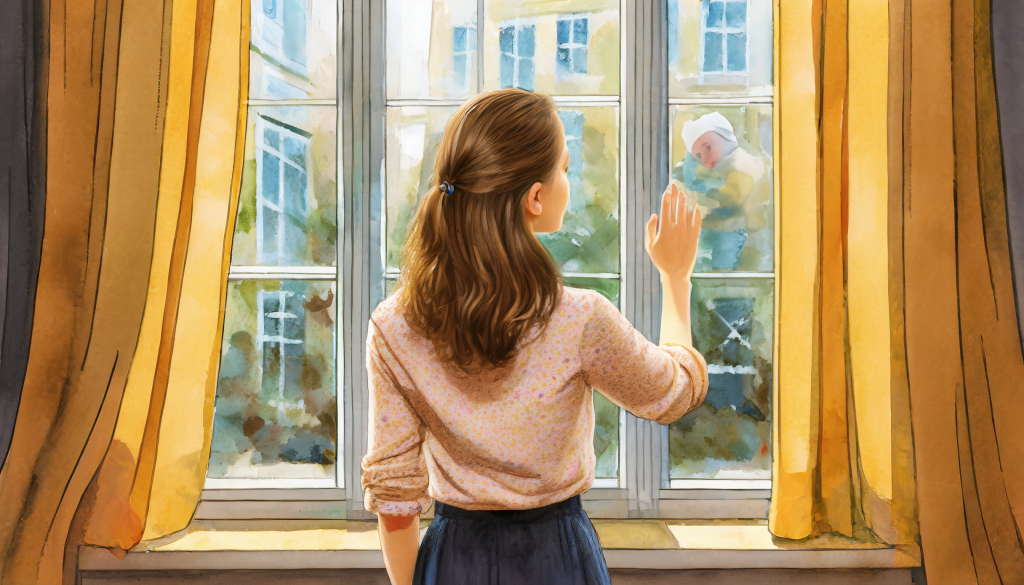
Recently I was watching a video on YouTube and the commentator was addressing an article in The New Yorker titled The Morality of Having Kids in a Burning, Drowning World. In it, the author, who is on the extreme side of “climate change” alarmism, discusses in meandering, confusing jargon a strange topic: is having kids the right thing to do? Can having kids be right or wrong?
The world for years has been on the fence about children. On the one had, they were a powerful political tool. We all remember the leftists of my childhood constantly accusing their political opponents of harming “the children” in some vague, indeterminate way. But on the other hand, children were seen as a burden, not just on their parents, but on society, the economy, the ecosystem, and even the world. Somehow the world was in love with children and despising them at the same time, like a kind of moral schizophrenia. But of late, one side of this mental instability has been winning out: that having children is a bad idea. There are numerous arguments, from the vapid, self-gratifying perspective of the self-described “DINKs” (which stands for Dual Income No Kids), to the barely-coherent philosophical ramblings of environmentalist feminist journalists and authors (such as in the article I reference) who can’t seem to make up their mind but are pretty sure that if they have a child it will cause the extinction of mankind. It all has to do with culture… or society… or the patriarchy… or icebergs?
Many people choose not to have kids for some reason that lands somewhere on that spectrum. Some of them are patently ridiculous:
- “I want to be able to buy snacks at Costco and go on vacation whenever I want!”
- “If I have a child, they will produce more pollution and that will kill the planet!”
- “Pets are so much easier than children! I love my fur babies!”
- “Having a child is too expensive in today’s economy!”
Some of the reasons, however, seem to have merit. Whether you believe the rising sea levels will destroy half of humanity, or you simply look out over a world where perverted men in womanface read books to children in libraries, teens raised by 30-year-old children are crossing state lines to murder their children, and people are being arrested for sharing information on social media, you could easily say, “Why would I want to bring a child into this? In 50 years, everything will be so much worse than it is now, who would want to live through that?” There are even Christians who have such concerns. In fact, I have had such thoughts as well.
The End is Nigh
For those concerned with the climate and convinced that man is destroying the environment, should you pollute the world more with your children? At first thought, the question of the End seems to have a strong case, but the reality is actually far more apparent, and surprising than it seems. If you believe the world is a bad place, how is not having children going to make it better? After all, the world is a massive celestial object, and the life upon it seems beyond our ability to significantly impact. The nuclear disaster at Chernobyl that occurred in 1986 had been all but forgotten by the life in the area only a few short years after it occurred, resulting in returning wildlife that was significantly more resistant to radiation. If the world’s oceans rose and cities were sunken as in the alarmists’ fears, life itself would go on. So what is the fear, really? That the earth itself would split in two? Not in most cases. In most cases, the fear is that humanity will destroy itself by its actions, and that is something that environmentalists are trying to prevent. Now, there are those who believe that humanity is (as Agent Smith famously said in The Matrix) “a disease” and that the earth would be better off without us, but that is a fringe idea. Most people, even environmentalists, want people to live in harmony with the earth. But their idea that we must resist the urge to have children (more on that later) and create a society where having children is considered morally wrong (because of the environment) is self-defeating. We already have a population crisis in this country. Already the birth rate is unsustainable, and what do we have to thank for that? Our ideas about having children, of course.
People are discouraged from getting married until they’ve dated around until some unspecified time when you don’t date around anymore. By that time you’re in your late twenties, and if you do get married (or shack up), you still don’t have children. Because even if you’re not a “DINK” you still have been told that you should spend a number of years with your spouse enjoying the good life before ruining it all with loud, overbearing, selfish little diaper-fillers. By that time, you’re well into your thirties, and the child-bearing window for most women is already starting to close. Combine that with the moralization of abortion (an inevitable end to the free “love” and hook-up culture encouraged and thriving since the 70s), and you have a significant population of America which will not even be able to have children, once they’re finished following all of the rules they have to follow in order to avoid following the rules their parents and grandparents followed. So why write an article pondering whether to have children because of climate change? And why even have climate activism at all? After all, people are killing the planet, and we are well on our way to causing the end of humanity in order to avoid it. So, as long as people continue to increasingly believe that having children is bad, eventually all of the DINKs will realize too late that there won’t be anyone left to enjoy the environment when they’re gone. So don’t worry, the “end” can only accelerate the process of human extinction, which seems to be the ultimate goal anyway. You can all go home now and enjoy your Costco snacks and puppies until we die out. If that isn’t the goal, then have children. If the world needs saving, who is going to do that but more little environmentalists? Don’t wait for someone else to increase the supply of alarmists, do it yourself, and save humanity and the environment in one stroke.
The 2018 monster film A Quiet Place was noteworthy because in the midst of its rather ridiculous premise (nearly indestructible aliens that hunt only by sound plunging earth into societal collapse), there was a meaningful moral that applies to this topic. In the film, the surviving family has learned how to be absolutely silent, using sign language and ambient noise to hide from the ever-present monsters. They have a number of children, one of which (due to the fact that he is a child) is killed early in the film. Children lack self-control and are inherently noisy. This is certainly no world to bring children into: and yet the mom and dad decide to have another child, in spite of the extreme difficulty and hardship this would bring. Childbirth alone, with its accompanying pain, not to mention the resulting crying infant, would doubtless lead them all to ruin. But they pressed on. Why? Because to cease to have children would have been an even more certain way to cause their end. They could have had no children, but then what? One by one they are killed off or die of old age, and humanity ceases to exist. The result is the same. At least by having children, they engender the possibility that if the world does go on, there will be someone around to enjoy it.
But what about the Christian? The question is fair: Is it wise to bring children into the world when it is in such a state of moral decay? Many Christians believe we are in the End Times, and there is certainly good reason to think that. Why would anyone want to start a family, let alone a large family, when the odds are that your children will live in a worse world than you did, maybe even startlingly worse? Well, a garden is not successful without being tended. Christians are the salt of the earth, as Christ says, and the more salt the better it is able to preserve. What if the End isn’t for another hundred years, or two hundred, or a thousand? If you bring children into the world, and teach them what’s right, they can then fight for the ideology that can bring change. Evil will always be present in this world, both in the form of Satan, and the darkness that is a fixed part of every human heart. Some eras are very bad, some are not, but if we do not bring more potential Christians into the world how can it be improved? Does God need us to do this? No, certainly not. But notably, He choses to use human beings, as we find throughout the Bible. We need to have children, bring them up in the Word and teach them about God, until we have sufficient numbers to bring about change in our families, in our communities, and in our land. Remember, Adam and Eve were not encouraged to have children, but were commanded:
And God blessed them, and God said unto them, Be fruitful, and multiply, and replenish the earth, and subdue it: and have dominion over the fish of the sea, and over the fowl of the air, and over every living thing that moveth upon the earth. – Genesis 1:28
The Urge to Multiply
One of the reasons for the rambling, disjointed and confusing nature of the article I mentioned above is that the writer was trying to somehow psychologically dismantle the urge that both she and the woman she quotes in her article felt: the urge to have a child. In the short time I have gone around the sun on this blue marble, I have noticed it too: the vast majority of women have a tremendous urge to have a child. Men also desire children, and sometimes it is quite powerful, but it is nowhere near as strong as what a woman feels toward the idea of childbirth. I think that is likely because for them, it is a physical, life-altering experience. Women, after all, can do many things in life. They can work, study, exercise, drive (some of them), lead, fight, compete, and so on. But all of these things a man can do as well, whether better or worse. Having a child, however, is something only women can do. It is literally the most defining physical attribute of womanhood. A man can cause children to come into being, which is significant in its own right, but a woman physically creates them inside her body.
The author of the article mentions that she believes curiosity is one of the reasons even women who don’t think they want children ultimately end up having them. I think she has a point. How many of us as men, owning a sports car, would drive it around at the speed limit for its entire lifespan? The defining feature of a sports car is its ability to go faster than all other cars. If you never even attempted to go fast, what would be the point of owning it? It would be more practical to own a Toyota Camry. I do think that women, especially as they get older and have experienced a lot of what life has to offer get curious. They have gone to a thousand bars, they have worked themselves to a great career, they have dated (and sometimes married) countless men, travelled, and so on. And then, toward the end of their lives, they realize their body has a unique, miraculous ability: to create a tiny version of them. And they do long to experience what that is like, despite all they know of its inconvenience. But whether you believe in God or evolution, is not this the drive of all humanity? We are finite beings, and we will pass from the scene, as countless humans have before us. What impact do we have on the world? What legacy do we have? Whether we are remembered or not, what have we contributed to the world? Deeds and acts can have an impression on the world for a time, but the vast majority of people cannot do anything so great as to be remembered by history. But bringing a life or more than one life into this world that will live on when you are dead: there can be no greater legacy for a human being.
And this is where the desire to have children among men is the strongest. I remember seeing the film Star Trek: Generations when I was a kid. In it, an alien scientist called Soran (played by Malcolm McDowell) finds a way to live forever through some improbable, supposedly natural phenomenon, and is willing to kill millions of innocent people to reach that goal. He is trying to avoid death, no matter the cost. At one point he delivers this haunting monologue to the protagonist, Captain Picard:
“You know, there was a time when I wouldn’t hurt a fly. Then the Borg came, and they showed me that if there is one constant in this whole universe, it’s death. Afterwards, I began to realize that it didn’t really matter. We’re all going to die sometime. It’s just a question of how and when. You will, too, Captain. Aren’t you beginning to feel time gaining on you? It’s like a predator. It’s stalking you. Oh, you can try and outrun it with doctors, medicines, new technologies, but in the end, time is going to hunt you down and make the kill. They say time is the fire in which we burn. Right now, Captain, my time is running out. We leave so many things unfinished in our lives… I know you understand.”
The monologue has deep meaning for Captain Picard because just prior to this, he had received news that his brother had perished in a fire, along with his family. Later, when another crewmember comes to talk to him about his loss, he explains the added depth of hurt that the news brought. Not only was a loved one and his family gone, but as a result of that, their whole family would die out. He tells her how when he was a boy he was told stories of all the great Picards in their family, who did great deeds. He confesses that when his brother had children, he felt it was not his responsibility to carry on the family line. He is old now and has no family of his own, and in a heart-wrenching scene, he laments:
“You know, Counselor, recently I have become very much aware that there are fewer days ahead than there are behind, but I took some comfort from the fact that the family would go on. But now there will be no more Picards.”
As a man, the scene hits quite hard. For a woman, there is an innate desire to procreate, to feel those sensations and experience to know and love the real life person that comes directly from her body. But for a man, a child represents something that is as old as humanity itself, whether you believe in the Bible or not: a man, no matter how great he is, is but a part of a larger whole, a whole to which he bears a responsibility. Society has done all in its power to rob both men and women of these desires, these urges, and in large part they have succeeded, but they cannot altogether remove something so innate. All the world can do is attempt to distract us with pleasures, work, achievements, moving images, sexual gratification, art, and so on. But the moment a man or woman stops for a moment, they may realize that none of that matters. All of the inconvenience of children, all of the money you may spend, all of the pain and difficulty they may cause you doesn’t seem so great because they are your legacy, and without them, you will die and nothing you have done will really matter.
All of the above applies to the unbeliever, but as Christians, we bear more than just a desire for legacy. There is a reason that the Bible has long stretches of genealogies in it. Yes, it can be for sake of dating and timekeeping, but I believe the genealogies in Scripture help us to make an important realization. When you read a long list of names in the Bible, you may wonder, “Who in the world are any of these people?” The answer is clear: no one. None of them were of any significance from a worldly point of view, and the Bible itself mentions no more than their name, their father’s name, and their son’s name. But the epiphany I had was that I am one of those people. I may achieve some success in life, but I highly doubt I shall be influential, famous, or wealthy. But even if I am, in the end there will be nothing more truly significant about me than where I came from in my family, and where I am taking my family when I die. In the Gospel of Luke, chapter 3, we are given a long genealogy that impressively reaches all the way from Adam to Christ. There are dozens of names in the list, but very few of them are of note or recognition. There are David, Jesse, Obed, and Boaz (spelled Booz in Luke), and there are the patriarchs: Judah, Jacob, Isaac, and Abraham. There is even Methuselah (spelled Mathusala), and Enoch, as well as Noah (spelled Noe), and of course Seth and Adam. But there are many names, like Menan, Jose, Heber, and so on. These were men of which there are no stories in Scripture. But they share in the legacy. They may not have been of any note as far as deeds, and may have just lived simple lives, or they may have been great, but not enough to be remembered for it. You do not know what plan God has for your family, but whatever it is, you have a part to play in it, no matter how small. You may just be a name in the grand scheme of things, but the plan couldn’t happen without you, or without your children.
As arrows are in the hand of a mighty man; so are children of the youth. Happy is the man that hath his quiver full of them: they shall not be ashamed, but they shall speak with the enemies in the gate.
– Psalm 127:4-5
I would love to do a devotional just on that one verse, because there is a lot of meaning to be unpacked from it, but suffice it to say, children are your legacy, so make as many as you can, in the end all of the toil and heartache will be worth it (Note the word “happy” in verse 5). In ancient and Biblical times (even into Medieval times) people understood this to be true. This is one of the many reasons that animals (specifically cattle, such as goats, sheep and cows) were so valuable, because they were living things, that reproduced. That was wealth that would follow your descendants after death, potentially, and increased over time, like children. That is the real reason that Abraham and all of humanity until about the last few hundred years valued their family line, and took great pride in not only their lineage (where they came from) but in their legacy (where they were heading to). And that is the real reason behind both the value and power of women throughout history, as well as the reason for them being treated as property for much of antiquity: they were key to the continuation of the family line. This is why Hannah so desired a child, even if the child was to be given to God. He would still continue her family’s line. This is why after the tribe of Benjamin was nearly wiped out after their horrific acts in Judges 19, the other tribes gave the survivors of Benjamin license to literally kidnap women from Jabesh-Gilead, a town that had not joined into the conflict: they did not want the entire tribe of Benjamin, the line of the patriarch Benjamin, to end completely. The morality of that decision is not the focus of this article, but the fact is obvious: in ancient times, legacy was everything.
God’s Legacy
Our legacy is our most important, most lasting mark upon this world. Through it, we influence generations of the future, and to neglect it is a tremendous mistake. God Himself has a legacy, for He has a Son, and through that Son, He has secured for Himself an innumerable host of children.
But as many as received him, to them gave he power to become the sons of God, even to them that believe on his name. – John 1:12
For as many as are led by the Spirit of God, they are the sons of God. For ye have not received the spirit of bondage again to fear; but ye have received the Spirit of adoption, whereby we cry, Abba, Father. The Spirit itself beareth witness with our spirit, that we are the children of God: And if children, then heirs; heirs of God, and joint-heirs with Christ; if so be that we suffer with him, that we may be also glorified together. – Romans 8:14-17
But we see Jesus, who was made a little lower than the angels for the suffering of death, crowned with glory and honour; that he by the grace of God should taste death for every man. For it became him, for whom are all things, and by whom are all things, in bringing many sons unto glory, to make the captain of their salvation perfect through sufferings. – Hebrews 2:9-10
Behold, what manner of love the Father hath bestowed upon us, that we should be called the sons of God: therefore the world knoweth us not, because it knew him not. Beloved, now are we the sons of God, and it doth not yet appear what we shall be: but we know that, when he shall appear, we shall be like him; for we shall see him as he is. – I John 3:1-2
When we repent of our sin and accept the gift of God, which is Christ Himself, we become heirs along with Christ. As Paul puts it in Romans 8:29, we are “conformed to the image of his Son, that he might be the firstborn among many brethren.” Our legacy on earth is important, because through us God can do great things now, and perhaps even greater things in the future through our descendants, and the values and morals that we will pass down to them. And through us, and potentially them, God’s legacy lives on through us and our children. That is why your most important acts on this earth are to have children, and to lead those children to Christ. All other pleasures, diversions, needs, and struggles pale in comparison to those two things.
 Word Weld
Leave a comment