
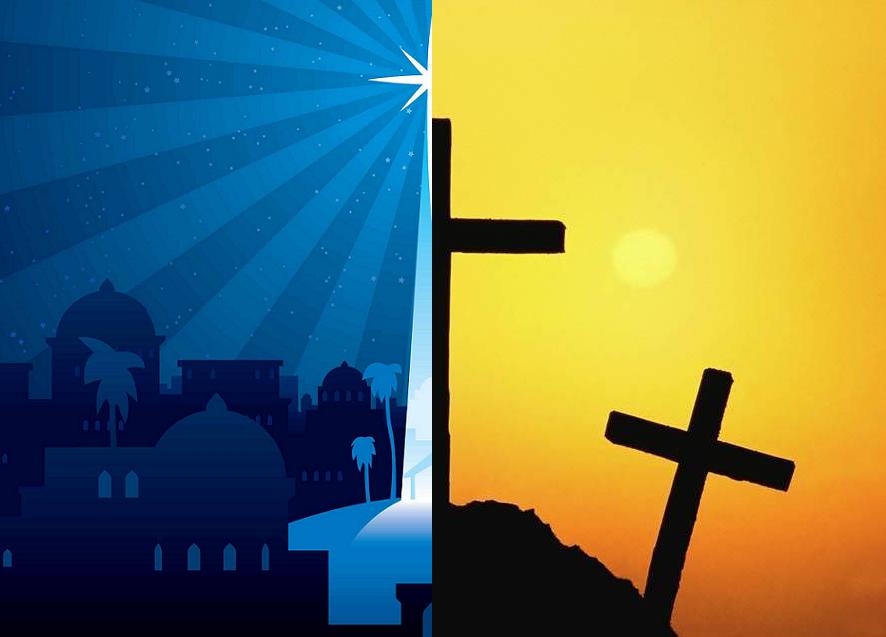
Christmas gets a lot of press, largely because of its secular, economic impact. It’s a pretty holiday, with things like cute baby Jesus, and snowy trees, and presents in shiny paper stacked under the tree. Everything about it seems clean and lovely. And then there’s Easter, which doesn’t get nearly as much traction because a) the Easter Bunny just doesn’t have as much appeal as Santa, and b) who likes a holiday about a man getting tortured and then murdered, and coming back to life again? Not cool, right? Of course, there is a movement among Christians to bring Easter back into focus, but many of these well-meaning Christians argue that Easter should be the most important Christian holiday, and that Christmas is comparatively unimportant.
I applaud those people for seeking to move the spotlight back onto Easter. Frankly, it simply doesn’t get the attention it deserves, even from Christians. That being said, Easter is not more important than Christmas. It is, however, no less important than Christmas. If there is one thing I find frustrating about human nature it is that people can’t just pull back from something. They have to jerk back violently, so that when we realize we’re too close to one side of the stream we panic and immediately run aground on the other side, then get out and drag our battered boat out of the water entirely, then hook it up to a truck and drive it to the next county. But it’s all good, because at least we’re not on that side of the stream anymore! No, no, no. Let’s not fall victim to extremism (you know, the tendency to go to great lengths to distance ourselves from one evil, only to end up in another).
Christmas is important. In fact, without Christmas there could be no Easter. So, that makes Christmas superior, right? No. Easter is also important, because without Easter Christmas has no meaning. So Easter is superior? Wrong again. I like to think of Christmas and Easter as two ends of an axis about which Christianity turns. They are complimentary and mutually necessary, a beautiful marriage of concepts.
On Christmas, we celebrate how Christ came into this world. And that is not just a turn of phrase, because it was no small thing for God to robe Himself in the stuff of our making, and put upon Himself weakness and frailty, as well as mortality. The idea of the Incarnation of Christ is, just like Christ’s death on the cross, a concept too great for the minds of men, so we say that “Christ was born” or that “Christ came down” or even “the Word became flesh.” But can we fully appreciate the import of these words? God literally became man, not for any purpose more than to help us overcome the evil that we are cursed to endure. Without Christmas, we would just have a man dying on the cross, and not a God-man, or we would have nothing at all–no salvation, no hope.
Yet if Christ merely lived as a God-man and then returned to Heaven, or if He died and remained dead, Paul says we as Christians would be of all men most miserable. What good is a God-man if he does nothing for us? Christmas was part of the plan, a necessary and staggering part of it, a miracle in so many ways, yet Easter was the completion of the work; it was the final objective.
I encourage you all to magnify Easter more than you do, as much as Christmas, because they are an inseparable pair, though their days are so distant from one another. Easter does deserve more attention from Christians, because it is the other side to the Christmas coin, a matched set, the sequel to Christmas that tells how the story ends. Let’s begin to come back to the middle of the stream, and realize that Christmas and Easter are equally important, and do whatever we have to in our homes and families to teach our children that Easter is a time of the year as precious as Christmas.
 Word Weld
Leave a comment