
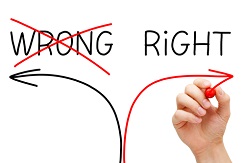
Normally I would put this kind of article under my “Mirror Muse” category, because I try not to get onto the soapbox or behind the lectern about most ideas in parenting. After all, every parent has to decide the best way to parent their own children, and despite what doctors and psychologists seem to think, every child is so radically different from every other child, including their own siblings, both mentally and physiologically, that putting them into boxes of development or behavior would be laughable if it weren’t tragic and ultimately wrong. But “wrong” is what I want to talk about, and while there are numerous parenting techniques or strategies that are legitimate for any given situation, there are rights and wrongs for all parents regardless of their situation or their children. My wife recently shared a conversation she was in on Facebook, talking about abortion, and it illustrated a philosophical flaw that we have birthed, which seems valid because it is based on two absolute truths, yet is erroneous. As parents, we have to be on the lookout for anything that would undermine one of our biggest responsibilities, and is actually what makes us parents as opposed to just caregivers or legal guardians. A few years back there was a young girl who got some traction on social media, especially among conservatives and Christians, for coming up with a logically solid statement of how abortion is wrong. It was excellent, and came largely from a secular viewpoint (not to say that the girl was secular herself, but only that the vast majority of her reasoning was purely logical). Well, this girl has grown up quite a bit, and the discussion that developed was on this young woman’s page, where she, my wife, and a few others were tossing around their ideas of what our response should be in regards to abortion as parents. The young lady in question, and a number of her followers, despite being strong pro-lifers, were suggesting that schools and parents ought to let children alone… that we ought to let children come to their own decision about how abortion is wrong. Furthermore, they argued, if we actually let children alone, they will come to that conclusion. After all, that’s what happened for the young girl in question. She got to a certain age, asked her parents about abortion, and they told her plainly, without any advice or counsel, that abortion is simply the killing of a child in its mother’s womb. Of course, the girl in question was mortified, and proceeded to make the video explanation that everyone, including myself, thought was so good. So there you have it. You give children the facts, and let them choose what’s right and wrong. As this young lady said, it was obvious because of her “innate sense of justice.” Wow, that sounds good. Really good. Almost as good as that offer for a million dollars from that guy in Africa that emailed me the other day. While I do not mean to be scathing or attack any of the people involved in the conversation, least of all this young lady valiantly defending the right of living people to continue being living people, this conclusion is false, and it is a dangerous falsehood. We get in trouble sometimes because deceivers know the best way to sell a lie is to build it upon a truth, or two or three. When Satan tempted Christ, he said,
And saith unto him, If thou be the Son of God, cast thyself down: for it is written, He shall give his angels charge concerning thee: and in their hands they shall bear thee up, lest at any time thou dash thy foot against a stone. -Matthew 4:6
Do you see what Satan did there? It was true that Christ was the Son of God, and the scripture he quoted was also true. So because A and B are true then C must be ok because it follows, right? The premise of what I’m addressing is summarized like this:
“Children have an innate sense of justice. If you give them the facts, they will automatically reach the right conclusion.”
This statement is false. In a perfect world, it might be true, but in a perfect world we wouldn’t be having this discussion, so it’s not really helpful at all to say. It is based on not one but three assumptions, which underpin it. First, there is the assumption that human beings have a natural sense of right and wrong. This is true. C. S. Lewis talks at length about it in Mere Christianity, where he calls it the “Moral Law.” Even the most depraved human beings know deep within their hearts what they are doing is wrong. Secondly, there is the assumption that people are naturally good. That is, given completely unbiased information, a child will not only reach the conclusion that an idea like abortion is wrong, but will also (and far more importantly) determine that wrong things shouldn’t be done. Doesn’t that seem obvious? In a perfect world, yes, but we’ve established how useless that statement is. Thirdly, there is the true assumption that children learn best what they learn for themselves. But that is not to say they aren’t taught, it is merely to say that the way they are taught should encourage self-discovery. The problem with this young lady’s statements is that she is taking many things for granted. For one, she is assuming she was a blank slate when the information about abortion was presented to her. She was not. After all, when her parents told her that abortion was “killing a child in its mother’s womb,” she latched right onto the word “killing,” and all kinds of red flags went up. After all, killing is wrong. But, did she know that innately? Was she born with the knowledge that killing is wrong? Yes, and no. Yes, she was born with a conscience, a Moral Law within her, that would make her feel badly if she killed someone. But that sense is not always enough to stop someone from behaving badly. After all, sometimes getting what we want is satisfying enough to overcome that sense. If it were not, Cain would never have been the first murderer. So, in order for her to come to the conclusion that abortion was wrong because it is killing and killing is wrong, she had to have had some other information. Whether it was her parents, her church, a relative, or some sort of secular moral influence, this young lady had been taught at some point that killing was wrong and that people shouldn’t do it, no matter how it makes them feel or how it benefits them. She had been taught it, and she had chosen to embrace that teaching. This was not a feeling or a sense that killing was wrong, but rather something that was taught. And that is what this debate boils down to. Parenting isn’t just keeping a child fed, and happy, and “crunchy,” and in a state-approved car seat, and out of the reach of firearms, and with sufficient interaction with other, similar-aged bullies and victims. Parenting is not about passing sterilized information onto a blank biological hard drive and believing that if no one else has put any information on there that the child will automatically turn that information into a working moral code of conduct, let alone one that lines up with the Bible. Some children will naturally gravitate toward order and common sense, while others will naturally gravitate toward chaos and self-indulgence. While all children indulge themselves to one degree or another, the severity of it is based on personality alone, which is not inherently evil, but is vulnerable to evil. What am I saying? Human nature. Children are a blank slate, yes, with only a limited conscience, a sense that some things are right and some are wrong, a sense that is easily overcome by whatever makes them feel good at the moment. And as children live, they take in vast quantities of information, largely without us even noticing, to the point it is frightening. But children don’t just take in facts and subconsciously dust off that tiny sense of right and wrong and apply it like law. They watch the people around them, and absorb not just the information, but how it is processed in others. As their parents, we are the first people they observe, and therefore we are the first people they copy. And copying, in reality, is a form of teaching! All parents are teachers, whether they wish to be or not. You can actively teach good things, actively teach bad things, passively teach good things, or passively teach bad things. But in order to have a positive impact you can’t blindly assume that the child is learning everything themselves. No, whether you wish it or not, you are their first teacher, and their first pastor, and their first counselor, and their first friend, and their first ruler. And, if you want to be, you can also be the best one of all of them, because if working at a girls’ home for a year taught me anything, it is that children want acceptance from their parents more than anything, even if their parents are the worst parents in the world. Our children absorb our worldview. Whether we read them Bible stories at night, or read them books about how life came from a puddle of ooze an absurd amount of time ago, or if we just go about our lives, behaving as if we believe one or the other. They will hear what we say to others. They will see our values, whether we think it’s a big deal to read the Bible, or brush our teeth, or keep our house clean, or lie, or steal, or look at things we ought not, or behave in unseemly ways. Some will recognize bad behavior because their inner Moral Law means more to them, but most will not go against their parents without someone else teaching them something different. This is a huge responsibility, because the real question behind the abortion debate my wife was involved in was, do we have to teach our children abortion is wrong? Can’t they figure it out on their own? No. Human nature is no weaker when we are young. We will lean toward whatever makes us feel good or happy, to disastrous effect. Teaching is the only thing that acts against this natural force of corruption. But don’t just take my word for it.
Train up a child in the way he should go: and when he is old, he will not depart from it. -Proverbs 22:6
God even uses the phrase “train up” which is much stronger than to teach. It implies a disciplined regimen, practice, with increasing difficulty and yes, [realistic] expectations in mind. We are to be loving, but if we want to be as loving as we can be, we need to prepare our children for the world. Teach them what is right, and what is wrong, and give them the background. Tell them what we believe and that they should believe it too, and when they are teens and they come home from school or from college and demand, “Why do you believe in God? Why did you teach me that?” then you know your child is under their own philosophical power at last, and you say, “I’m glad you asked. Let’s sit down and talk about it, and then you come to your own conclusion about why you will or won’t believe in God.” The early years are not to be a time of freedom and self-discovery in every facet. Maybe they are in terms of what colors they like best, or if they like building with blocks, or painting, or animals. But they aren’t in terms of morality, and they aren’t in terms of respect for others. No parent could in any moral sense could justify abandoning their child on a street corner. Why should we abandon them at the intellectual street corner? Why should we throw them into the ocean and scream at them to swim without having told them how? Why would we drop them off in the middle of downtown and watch from a distance as they try to claw their way back home, even though they don’t know which way to go? Why are parents so afraid of influencing their children? Do we not realize that we influence them, even by actively trying not to? And even if there were a way not to, are we not fools to think that there are not host of evil people waiting for the chance to influence them in our place? We ought to know better. We ought to teach them our values, whatever they happen to be, because if we don’t, someone else will.
 Word Weld
Leave a comment