
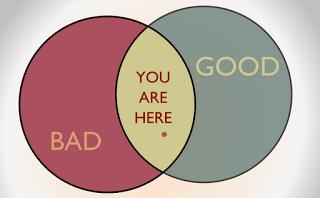
The genius Irish author and famed hedonist Oscar Wilde once said that art, like morality, meant “drawing a line someplace.” He said at another time,
“There is no such thing as a moral or an immoral book. Books are well written, or badly written.”
Wilde wrote very well, and was a connoisseur of the arts. He was intellectually a prodigy, yet he filled his life with debauchery and indulgence, destroying several lives in the process, and bringing about his own death.
I would like to make some distinctions about morality that were once common sense, but have in modern society been questioned or ignored to the point that society no longer generally accepts them as true. It could be said that the greatest lies are half-truths, and the greatest evils are at least partially good. Seldom do men embrace evil undiluted, loving it for its own sake. Indeed, it may well never be the case. Men accept evil only after it has been ideologically justified in their minds–until it in some way seems good, and has successfully masqueraded as good in their reasoning.
Nothing better illustrates this than Oscar Wilde’s life. His statement that morality, like art, is simply drawing a line, is a succinct expression of the philosophy that has at least partly led to where we are today in this world. Wilde did not disdain morality as a concept. Indeed, after a stint in prison he lobbied heavily for the rights of those in prison to decent conditions. However, morality to him was subjective, and when morality becomes subjective it loses all of its potency. In this sense, morality is the twin sister of Truth, for truth made subjective or relative is fit for nothing, and may as well not exist, but it does exist. And morality exists also, and something within us begs us to give heed to it. It hungers for us to behave a certain way, and only by giving it a suitable excuse are we able to live however we please. Just as a starving man will eat even tainted meat and moldy bread, we fling to morality the addled excuses our reason could cook up, sickening her until she can no longer trouble us.
Wilde did not believe morality was as a concept false or nonexistent. He simply believed that there existed concepts or behaviors that were outside of bounds of morality. Art and sexuality were the two that came to the forefront of his philosophy. It may be immoral to murder someone, but to glorify murder in writing is not, because writing is art, and art is outside of morality. It may be wrong for a woman to parade her nude body before the world, unless it is in a photograph or in a painting, because art is separate from morality. Is this true? Do things like art, writing, and sexuality exist outside of the pure touch of morality? Are things no longer wrong simply because we attach titles to them or think of them within a certain context? Why do we still speak of morality in politics, or ethics in business, yet find books, movies, video games, and paintings beyond such things. Are they really that different? Are they different at all?
The Bible does not use the word “morality.” Rather, the Bible uses the term “law,” and C.S. Lewis combines the concepts into the “Moral Law.” Wilde, and those like him, did battle with the concept of laws in their intellect, because they want to be free to indulge their own fancies and debauchery, yet wish to make sure that those wrongs they abhor are punished by society. Law, like morality, truth, and sexuality, cannot be subjective. Jesus Himself, with whom Wilde had many intellectual wrestling matches, made His position on the matter very clear.
“Ye have heard that it was said by them of old time, Thou shalt not commit adultery: But I say unto you, That whosoever looketh on a woman to lust after her hath committed adultery with her already in his heart.”
— Matthew 5:27-28
Christ is here nipping the moral ambiguity in the proverbial bud. The Moral Law says, don’t commit adultery. But, says Wilde, what about books glorifying adultery? What about virtual adultery? Those things aren’t wrong because no adultery was actually committed, right? Jesus says no. Jesus says that our thoughts alone are sufficient to damn us, and that is a chilling prospect. To play with sin and evil in our minds is, to God, no different from performing it, and with good reason: those who entertain sin and debauchery in their minds seldom resist committing them down the road.
Wilde was a great example of this. His philosophy that art was aesthetic only and morally neutral led to him justifying the consuming of erotic images, which in turn led to base thoughts, which became base lusts. These lusts eventually materialized physically, and for his bouts of “pleasure” that included homosexuality and sodomy he was ultimately imprisoned, and wrestled with God for two years in his jail cell. Yet, even after attempting to clean up his life and heart with God’s help, he fell back into his old ways, and died an early death, the ultimate end of a lifestyle denying the absolutism of morality. Wilde felt disgust and hatred for the cruelty of his situation in prison, which cruelty was apparent, yet missed the injustice of his treatment of innocent boys, which not only ruined his reputation but his marriage, and his life. While he had intended to reconcile with his wife after prison, and had written successfully to her, in the end he returned to his illicit behavior and alienated her to the point that when she died, she did not put her married name on her gravestone, a decision that cut Wilde to his heart. Wilde is said to have converted on his deathbed, but no one knows for certain. All we really know is what his life produced. Not only did it cause great damage in certain cases, and largely waste his great God-given genius, but it left an insidious legacy, where artists feel they are justified in producing anything from evil horror and violence to sexual promiscuity and perversion, and believe they are blameless.
Or do they? I believe that deep down we all know right from wrong. We may starve our conscience, or Moral Law, to the point where it can no longer trouble us, locked away in the dungeon of our minds, yet no matter how withered or emasculated it is, that Moral Law still exists. And the idea that it still exists means it is still meant to be followed, and we are rebelling against it. Michelangelo struggled with the idea of nude painting, and he too justified it, declaring to a teacher, “I want to see man as God sees man.” Fittingly, his teacher replied, “But you’re not God.” It is impossible for man to look upon nakedness without sensuality, as God can.
An awareness of true morality is built into each and every human being, even the most anarchistic. Even the purely selfish three-year-old understands morality at least as far as it applies to himself, and so do we all. Hitler preyed eagerly and relentlessly upon the Jews and other groups he saw as inferior, yet if he had been born into one of those groups, his outlook upon them and upon the supremacy of the Aryan race would doubtless have been much different. C. S. Lewis lays an amazingly simple and well-conceived foundation for God’s morality in Mere Christianity.
“How’d you like it if anyone did the same to you?”-“That’s my seat, I was there first”-“Leave him alone, he isn’t doing you any harm”- “Why should you shove in first?”-“Give me a bit of your orange, I gave you a bit of mine”-“Come on, you promised.” People say things like that every day, educated people as well as uneducated, and children as well as grown-ups. Now what interests me about all these remarks is that the man who makes them is not merely saying that the other man’s behaviour does not happen to please him. He is appealing to some kind of standard of behaviour which he expects the other man to know about. And the other man very seldom replies: “To hell with your standard.” Nearly always he tries to make out that what he has been doing does not really go against the standard, or that if it does there is some special excuse. He pretends there is some special reason in this particular case why the person who took the seat first should not keep it, or that things were quite different when he was given the bit of orange, or that something has turned up which lets him off keeping his promise. It looks, in fact, very much as if both parties had in mind some kind of Law or Rule of fair play or decent behaviour or morality or whatever you like to call it, about which they really agreed. And they have. If they had not, they might, of course, fight like animals, but they could not quarrel in the human sense of the word. Quarrelling means trying to show that the other man is in the wrong. And there would be no sense in trying to do that unless you and he had some sort of agreement as to what Right and Wrong are; just as there would be no sense in saying that a footballer had committed a foul unless there was some agreement about the rules of football.
So there you have it. And what good is a moral law if it applies to some things and not others? If we’re playing football, and I commit a foul yet claim that this particular foul is outside of the rules of the game, would that be admissible? What does that do to the other players, and to the game at large? Soon everyone will be claiming their fouls are for whatever reason outside of the rules, and the game will degenerate into a chaotic mess. Applied to society and reality, claiming that pornography doesn’t affect marraige or a man’s mind, or that naked women viewed on a painting are outside of morality, or that video games like Grand Theft Auto can have the player perform everything from theft to brutal sexual killings and be pure ethically is like saying morality as a concept does not exist. And go ahead, say that it doesn’t exist, but don’t complain when you are defrauded, stolen from, abused, or mistreated. If morality applies at all, it applies to every facet of life. Nor can Christian liberty or the Grace of God free us from the requirement to chose to be moral in life, from obvious things like not killing people, to mundane things we often would rather morality were outside of, like our choices of music, clothing (dare I say it), and entertainment. Because if we leave those things outside of morality, we lie to ourselves, and in the end our own supposed piety will turn into a kind of philosophical Calvinball where everything goes, not realizing that every game of Calvinball ended in confusion and sometimes violence. Man must have Morality, for no one wishes to be defrauded or wronged, and we know it is wrong to do bad things to others, yet we like to put philosophical frosting on our spoiled cake, not understanding that we shall have to eat that cake someday.
Christ said,
“Think not that I am come to destroy the law, or the prophets: I am not come to destroy, but to fulfill.”
–Matthew 5:17
Furthermore, in case some still think that grace means that we can act outside of morality because of God’s forgiveness, Paul said,
“What shall we say then? Shall we continue in sin, that grace may abound? God forbid. How shall we, that are dead to sin, live any longer therein?”
–Romans 6:1-2
We can pretend that morality does not apply to music, or to an art gallery, or the hot beach, or if it’s “just a game,” or if it “only hurts me,” but we should not be surprised when our house of cards comes tumbling down. It has for me, and it will for all who choose that self-lie. Morality cannot be “halvses,” intermittent, or convenient–it is all or nothing, and no morality is simply not an option.
 Word Weld
Leave a comment